Voltage, regeneration, body maps, and the search for living harmony.
Prepared for
bioelectricitycourse.com
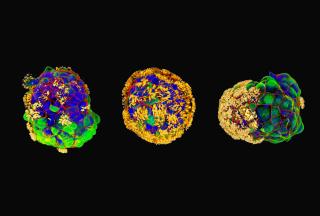
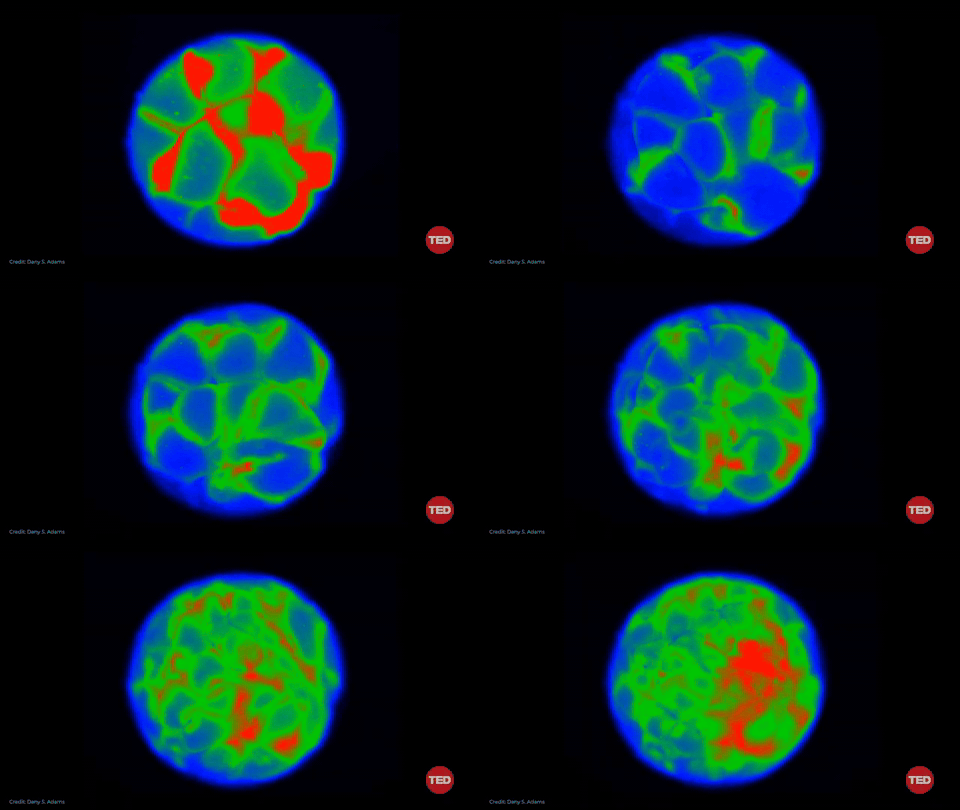
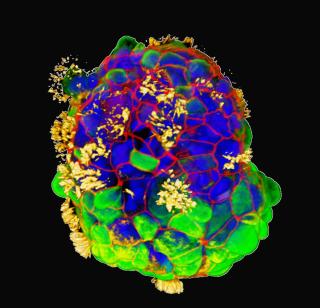
Imagery courtesy of the Levin Lab, Tufts University — Anthrobots: G. Gumuskaya et al. (2023) · Xenobots: D. Blackiston, S. Kriegman et al. (Tufts / UVM) · Membrane-voltage imaging & frog face prepattern time-lapse: D. S. Adams et al. · Planarian regeneration: Levin Lab. All rights remain with the original authors and journals.
01 / 49
Slide 02 · The throughline
Eight minds, one throughline.
From medieval experiment to modern morphogenesis — the thinkers this talk follows toward one idea:
voltage is a control variable for living anatomy.
Roger Bacon
c. 1219–1292
Knowledge from experiment, not authority.
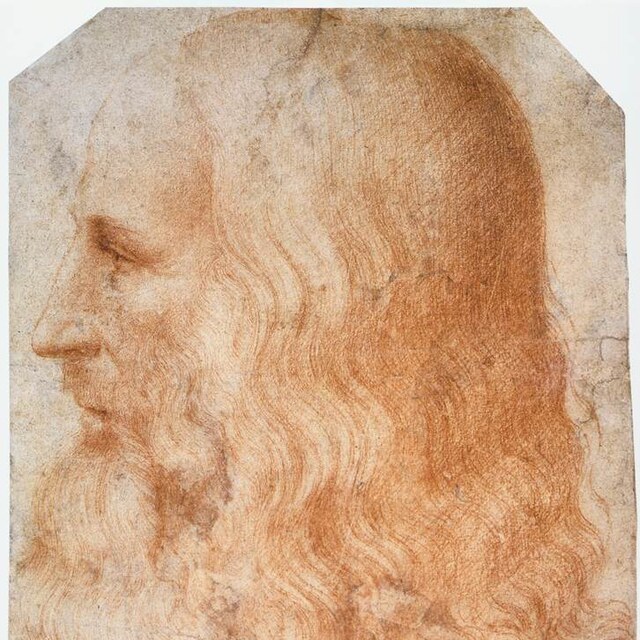
Leonardo da Vinci
1452–1519
Anatomy as measurement — form reveals function.
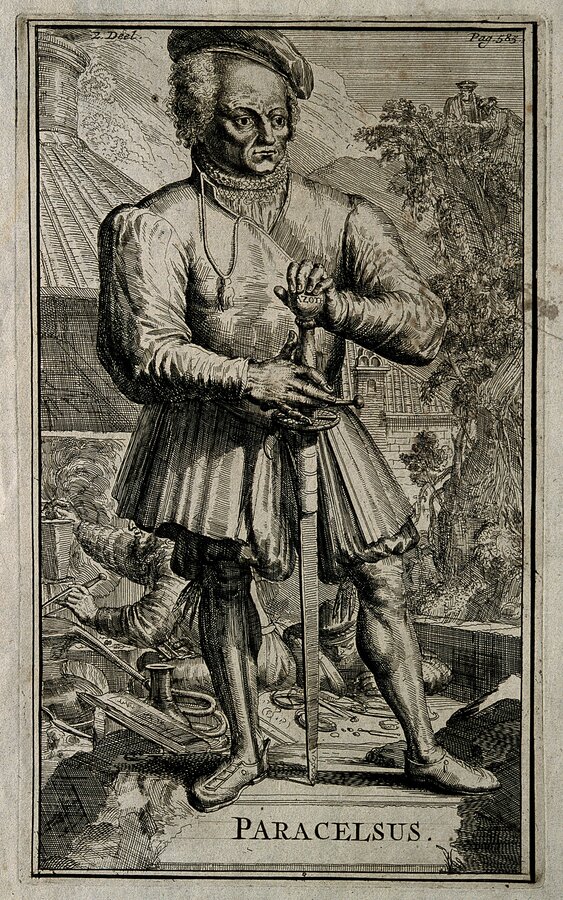
Paracelsus
1493–1541
The living body runs on chemistry.
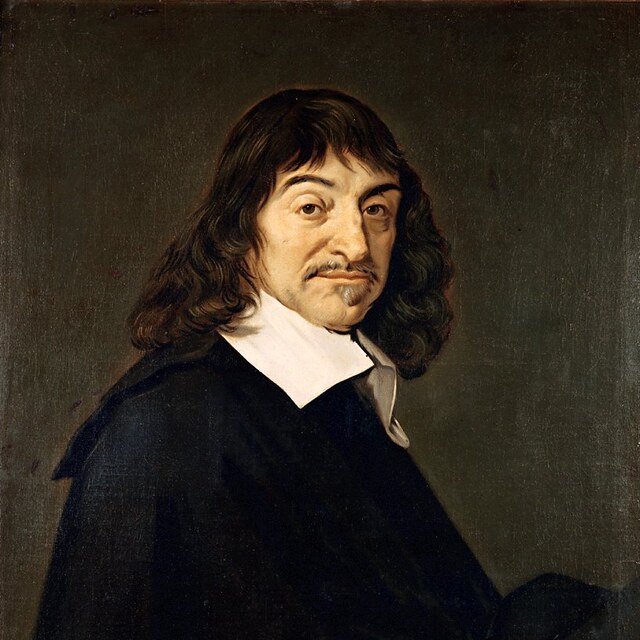
René Descartes
1596–1650
The body as a mechanism of signals.
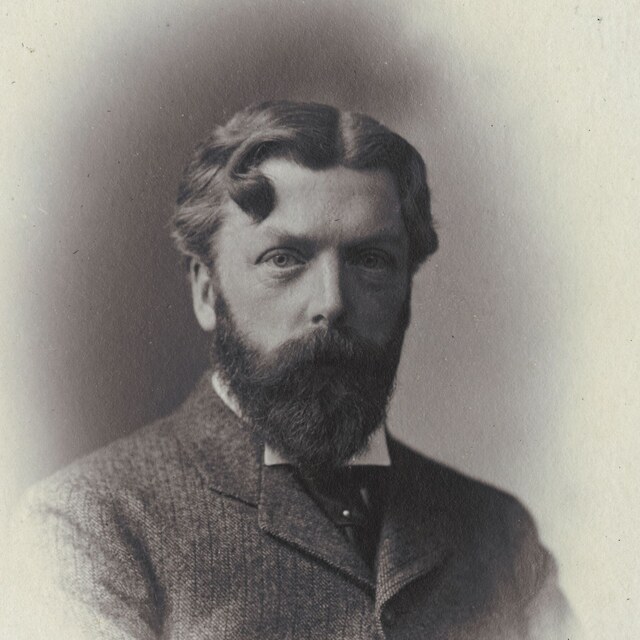
D'Arcy Thompson
1860–1948
Form is shaped by physical forces.
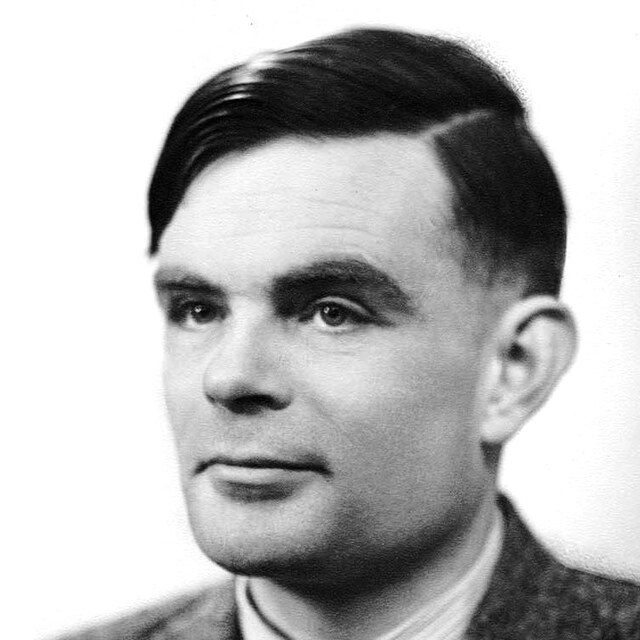
Alan Turing
1912–1954
Simple rules generate biological pattern.
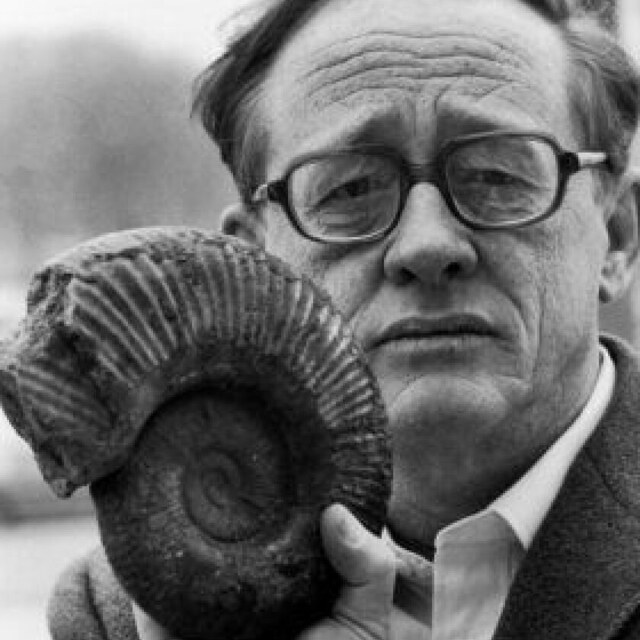
David Raup
1933–2015
Every real form sits in a space of possible forms.
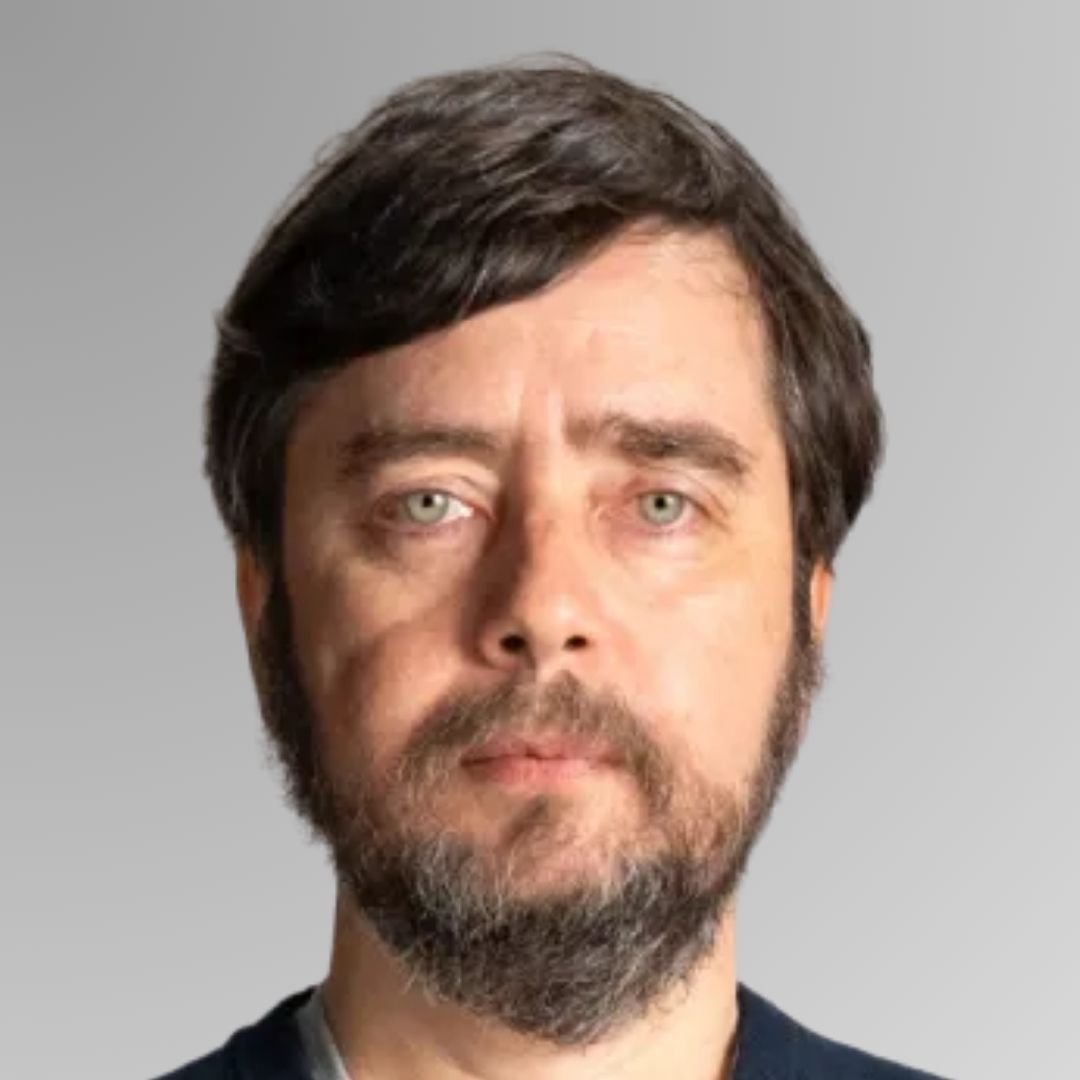
Michael Levin
b. 1969
Voltage is a control variable for anatomy.
02 / 49
Slide 02 · A brief history of healing
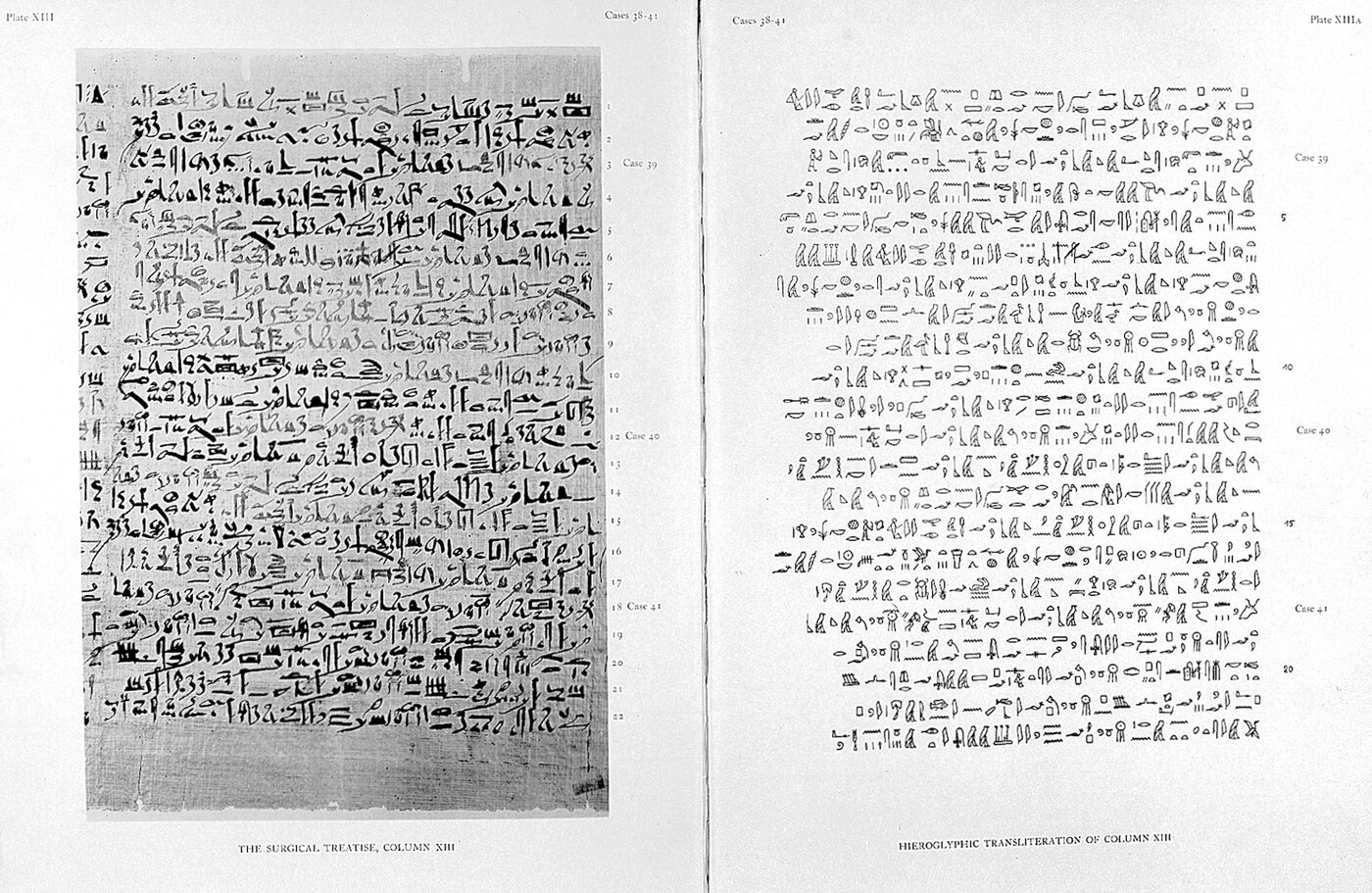
~1600 BCE (copy of a c. 3000 BCE original) · Edwin Smith Papyrus
The oldest known surgical text is observational, not magical.
Before humors or elements, Egyptian physicians kept case files. The Edwin Smith Papyrus
catalogues 48 trauma cases — mostly head and spine injuries — each with an examination,
a diagnosis, and a blunt prognosis: "an ailment I will treat," "I will contend with,"
or "an ailment not to be treated."
It is startlingly clinical for its age — closer to a modern trauma-surgery textbook than to a
book of spells, though magical remedies coexisted for internal illness elsewhere in the
Egyptian corpus.
The Edwin Smith Papyrus — case-by-case surgical treatise, c. 1600 BCE.
02 / 49
Slide 05 · A brief history of healing
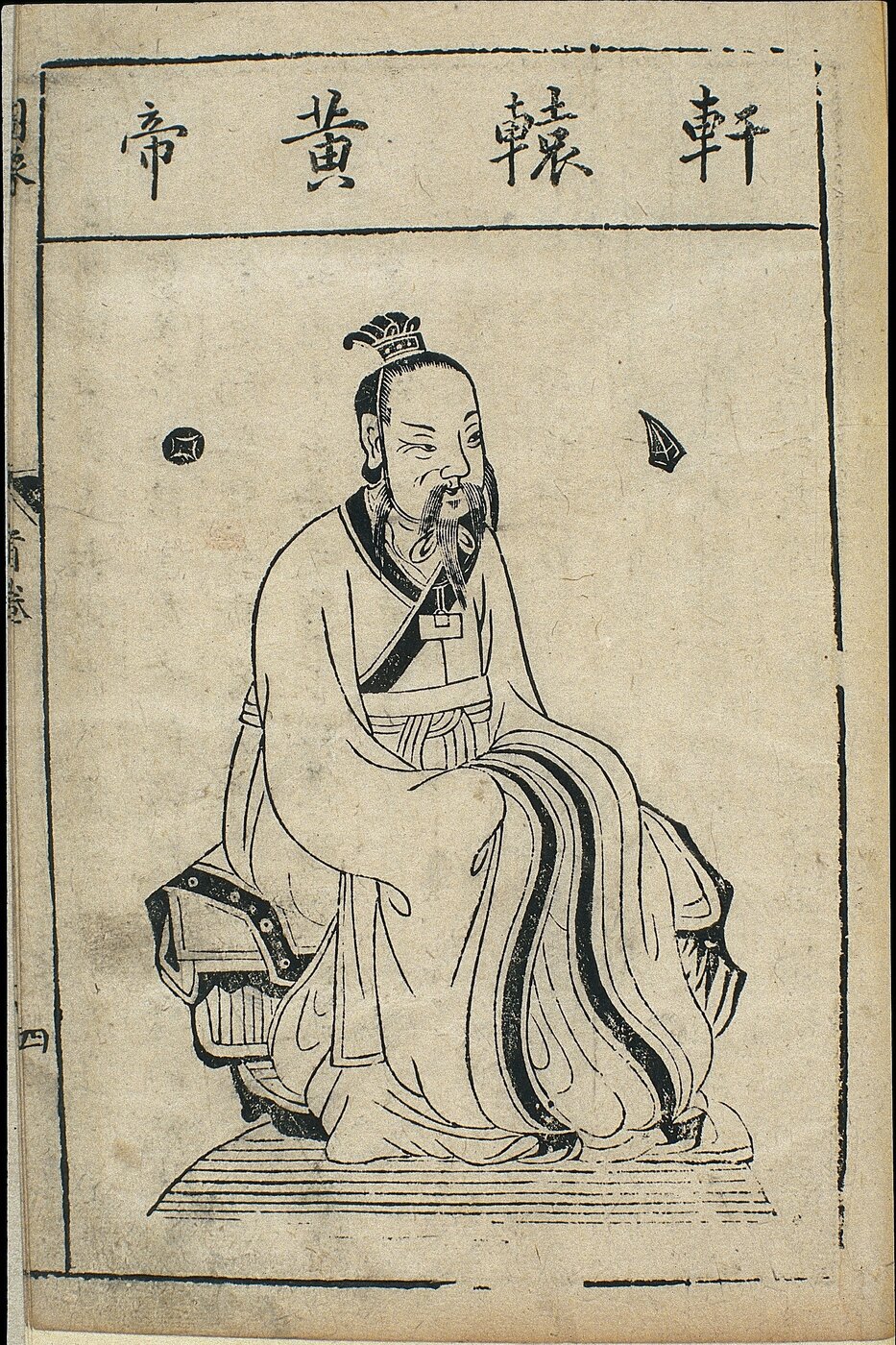
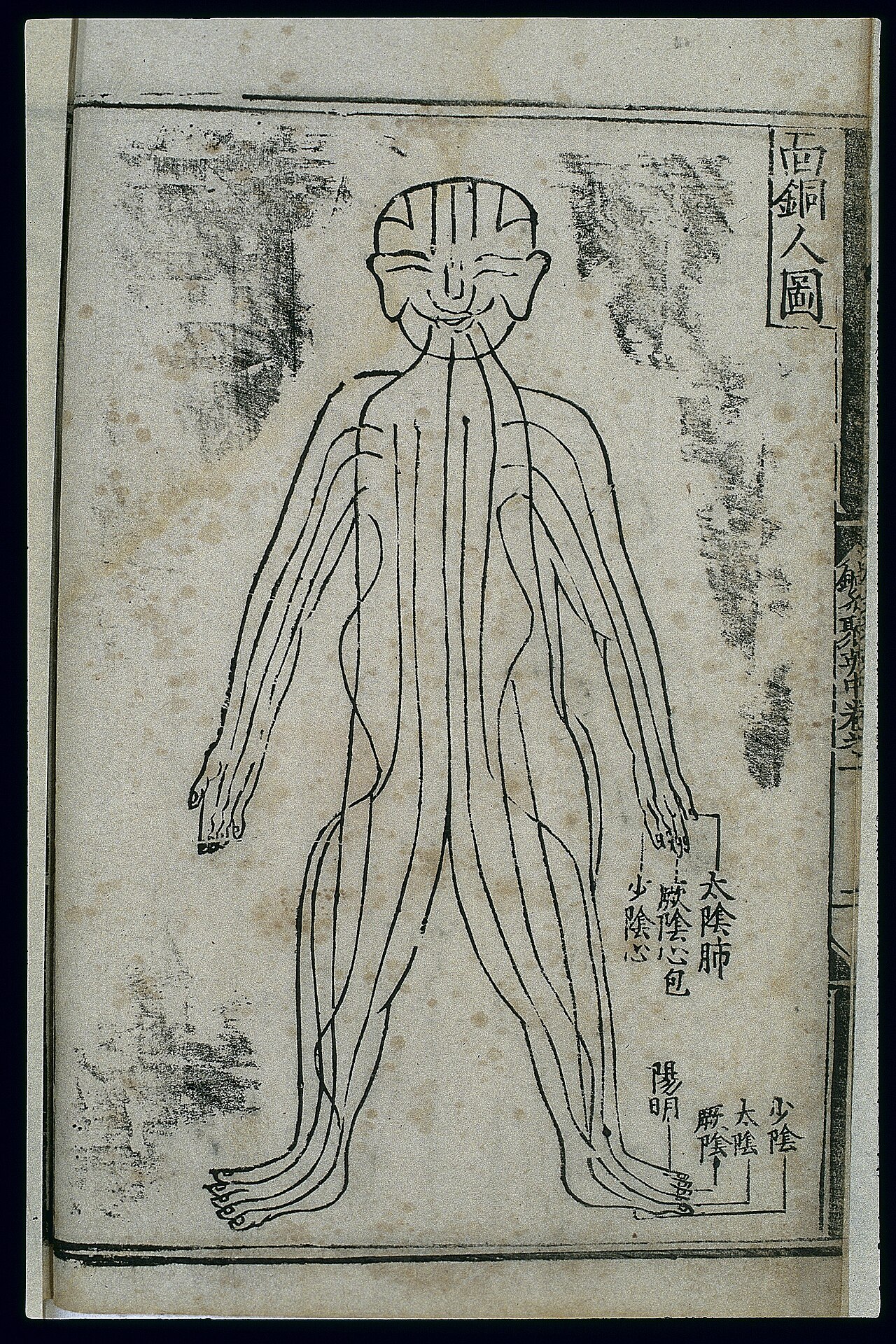
~300–100 BCE · Huangdi Neijing (The Yellow Emperor's Inner Canon)
Chinese medicine modeled the body as a circulating system.
The Huangdi Neijing, framed as a dialogue between the mythical Yellow Emperor and his
physician, proposes that qi — vital energy — flows through the body along channels called
meridians, balanced between complementary forces (yin and yang). Illness is a
blockage or imbalance in that flow; acupuncture and moxibustion aim to restore it.
Whatever one makes of qi as physiology, the underlying intuition — that health depends on a
continuously flowing internal signal reaching every part of the body — is strikingly close to
the bioelectric picture this talk builds toward.
The Yellow Emperor
Meridian map
05 / 49
Slide 06 · A brief history of healing
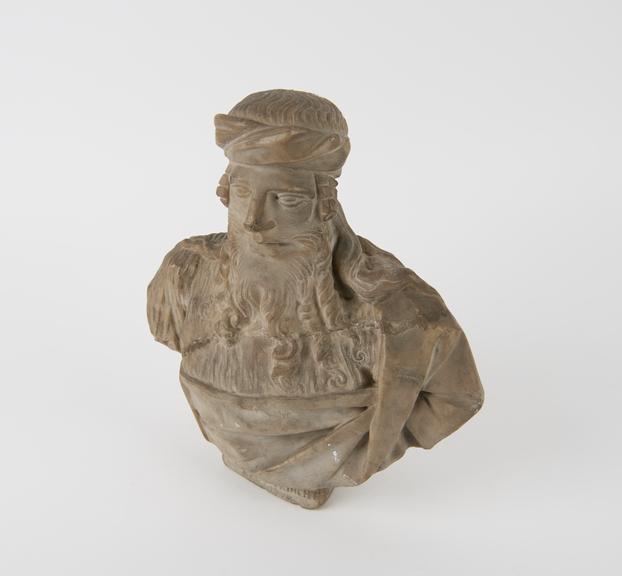
~460–370 BCE · Hippocrates of Kos
Hippocrates: disease has natural causes, not divine ones.
Hippocrates broke with the idea that illness was punishment from the gods. He argued disease
arises from natural causes — diet, environment, the body's internal state — and should be studied
by careful observation at the bedside, not divination. This clinical habit, plus the ethical code
that carries his name, is why he's remembered as the "Father of Medicine."
"Declare the past, diagnose the present, foretell the future." — attributed to the Hippocratic Corpus
The Rod of Asclepius — a single serpent on a staff — is medicine's true emblem, rooted in the Greek healing tradition Hippocrates belongs to.
A Renaissance-era marble bust identified as Hippocrates.
06 / 49
Slide 07 · A brief history of healing
~400 BCE – 1800s CE · Hippocratic & Galenic medicine
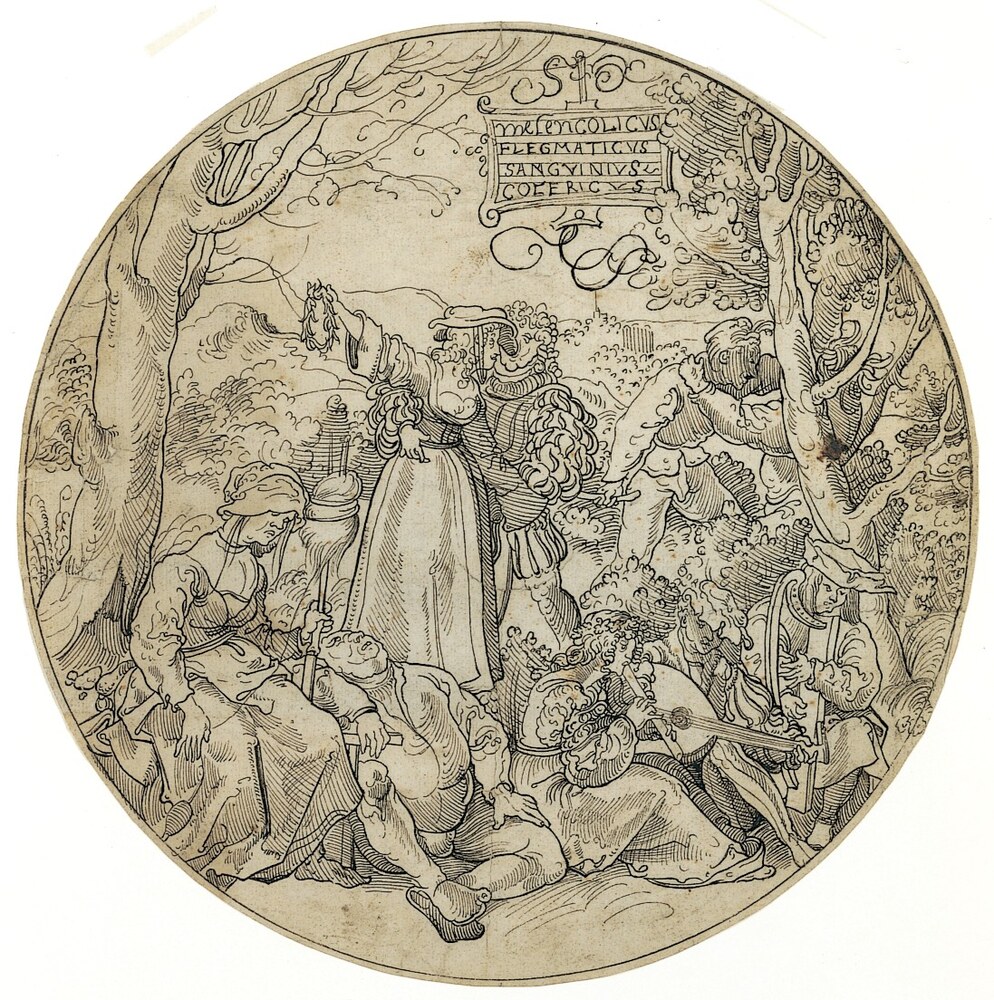
For two thousand years, healing meant restoring balance.
Before germ theory or chemistry, illness was explained as an imbalance among four bodily fluids —
the humors. It was never validated the way modern science validates a theory. It was
accepted: for two millennia, by authority, coherence, and treatments that sometimes seemed to work.
Blood
hot + wet
Sanguine — lively, social, hopeful
Yellow bile
hot + dry
Choleric — angry, bold, impulsive
Black bile
cold + dry
Melancholic — sad, fearful, reflective
Phlegm
cold + wet
Phlegmatic — calm, sluggish, reserved
The theory mapped the body onto Greek natural philosophy's four elements and four qualities, and it
looked observational — fever, phlegm, bile, blood loss were all visible. Sickness was excess or
deficiency; treatment meant bloodletting, purging, or diet to restore equilibrium. It survived from
Hippocrates through Galen into the early modern period — until anatomy, chemistry, and germ theory
gave medicine better tools for seeing the body than "balance."
The four temperaments in one Renaissance roundel — labelled melancolicus · flegmaticus · sanguinius · colericus. Pen & ink, 16th c. · The Met (CC0).
07 / 49
Slide 08 · Alchemy and medicine
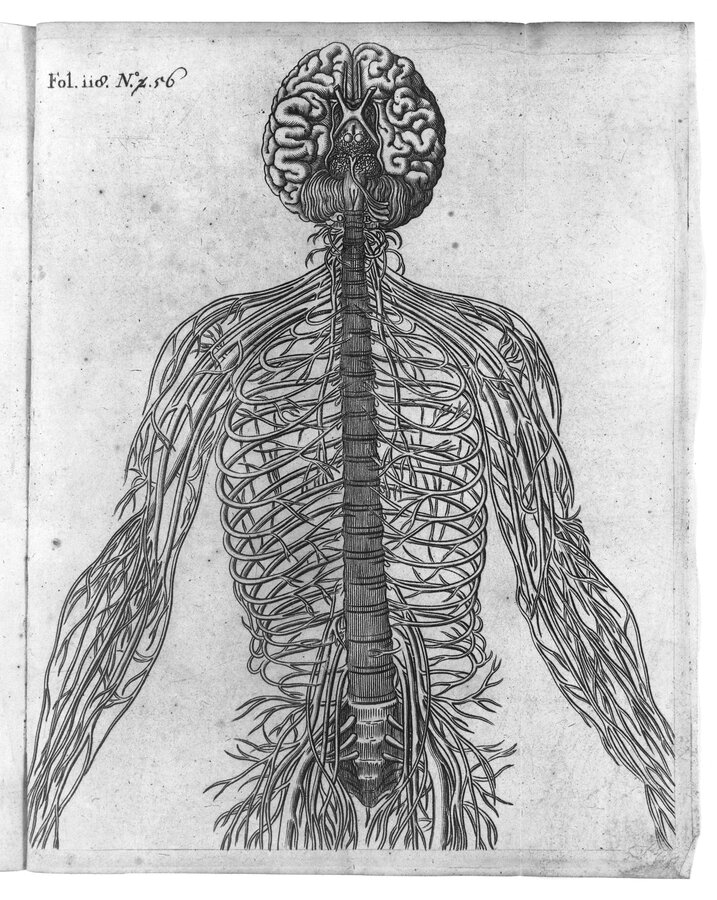
c. 850–1037 CE · Al-Razi & Ibn Sina (Avicenna)
The Islamic Golden Age turned medicine into a systematic science.
Scholars preserved and rigorously extended Greek medicine. Al-Razi (Rhazes) distinguished
smallpox from measles by careful clinical comparison and insisted therapies be tested before use.
Ibn Sina (Avicenna)'s Canon of Medicine systematized diagnosis, pharmacology, and
contagion theory into a single reference — used in European universities for over 600 years.
This is also where alchemy (al-kimia) itself is formalized as a discipline — the direct
ancestor of the European alchemical tradition this talk is about to follow into medicine.
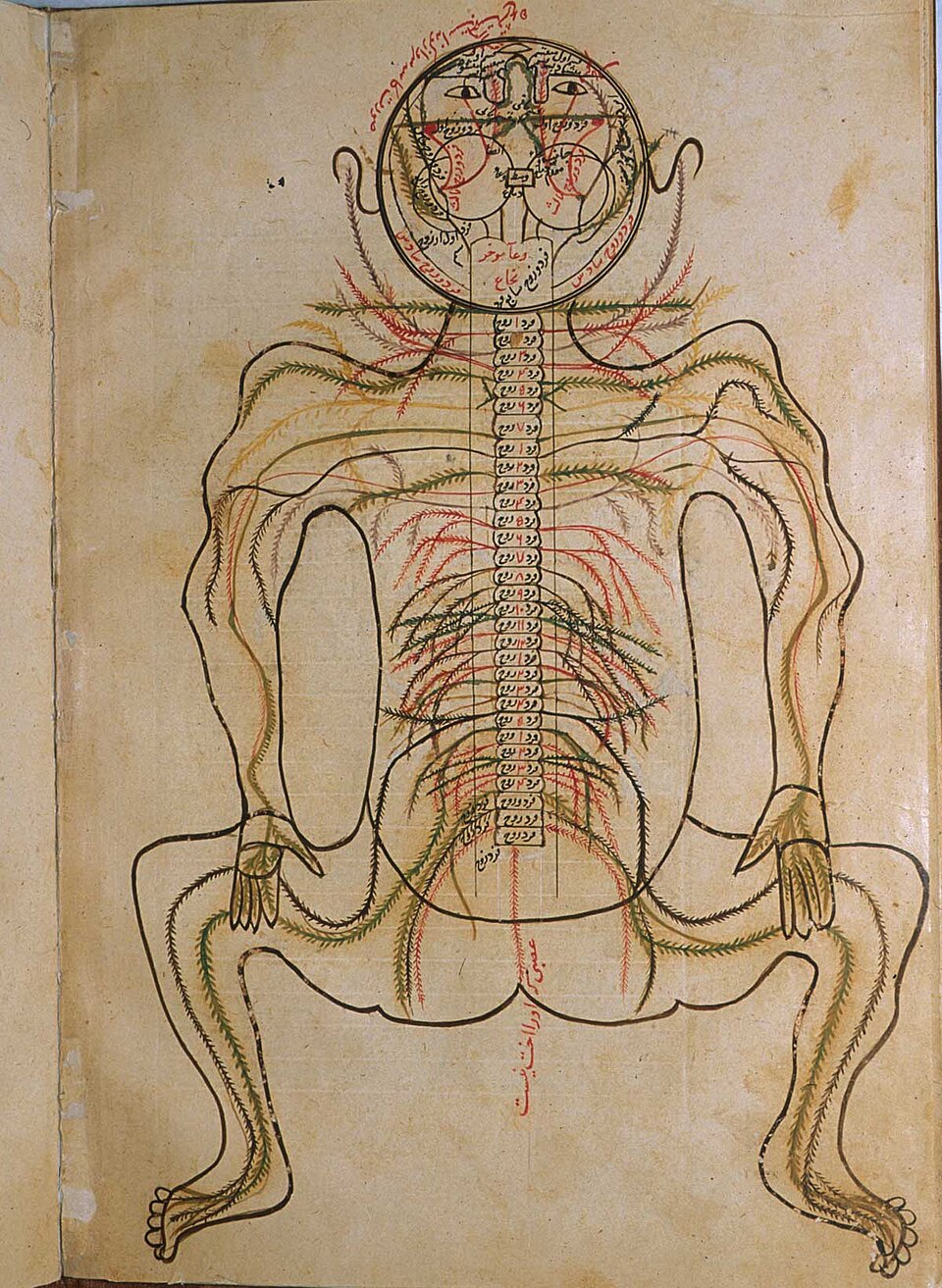
Full-body nerve map from Mansur's Anatomy — the Persian/Islamic anatomical tradition, c. 1390.
08 / 49
Slide 09 · Alchemy and medicine
1214–1292 · Roger Bacon
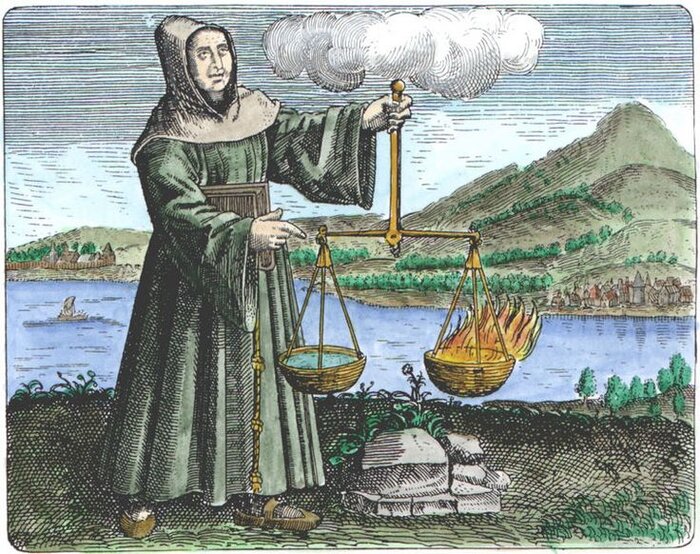
Roger Bacon: healing as restored harmony.
For Bacon, alchemy was not only about metals — it was a medicine of restoration. The ideal body
was one where the four elements were brought into equal proportion: the corpus equale,
"the equal / balanced body," less subject to corruption, disorder, and decay.
"Healing meant restoring proportion — a body brought back toward harmony."
Michael Maier, Symbola aureae mensae, 1617 — Bacon balancing fire and water.
09 / 49
Slide 10 · Alchemy and medicine
1347–1351 · The Black Death
The Black Death exposed the limits of humoral theory.
When plague killed a third of Europe, physicians reached for the tools they had: bloodletting to
rebalance humors, "miasma" (bad air) avoidance, purging, and aromatic herbs against foul-smelling
air (the iconic beaked plague-doctor mask came later, in 17th-century outbreaks). None of it addressed the actual cause — a bacterium
spread by fleas — and mortality was essentially unaffected by treatment.
The plague didn't discredit humoral theory outright — but it quietly built the pressure that,
two centuries later, made room for Paracelsus's more targeted, chemical alternative.
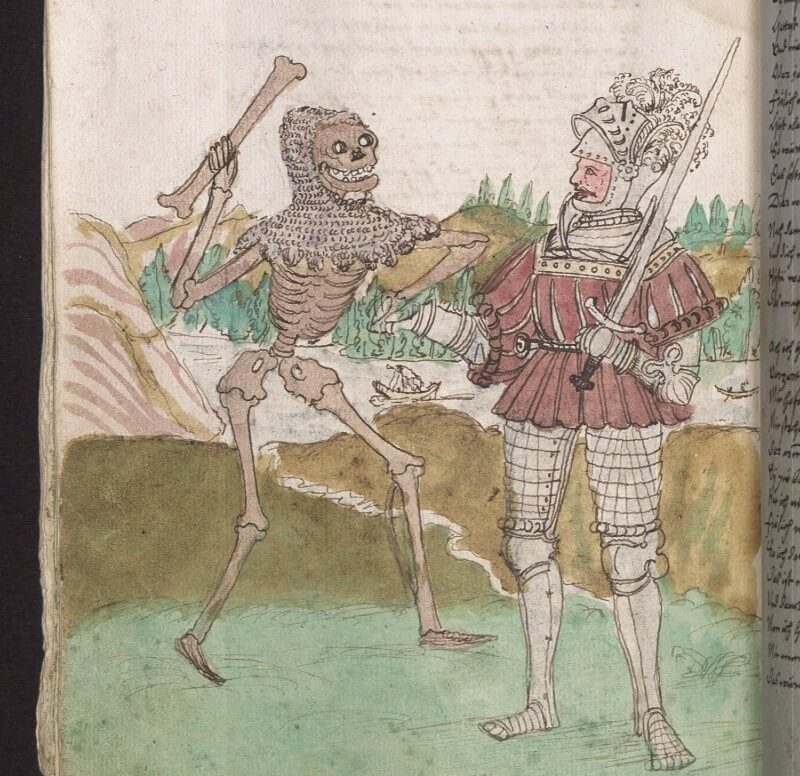
A "Dance of Death" manuscript illustration — Death confronts a knight, c. 15th century.
10 / 49
Slide 11 · Alchemy and medicine
1452–1519 · Leonardo da Vinci
Da Vinci: an artist's eye makes the body visible, measurable, mechanical.
While Bacon and Paracelsus reasoned about the body through elements and chemistry, Leonardo
reasoned through direct observation. His contribution was less a single discovery than a
method: observe the body directly, draw it from multiple viewpoints, and explain structure
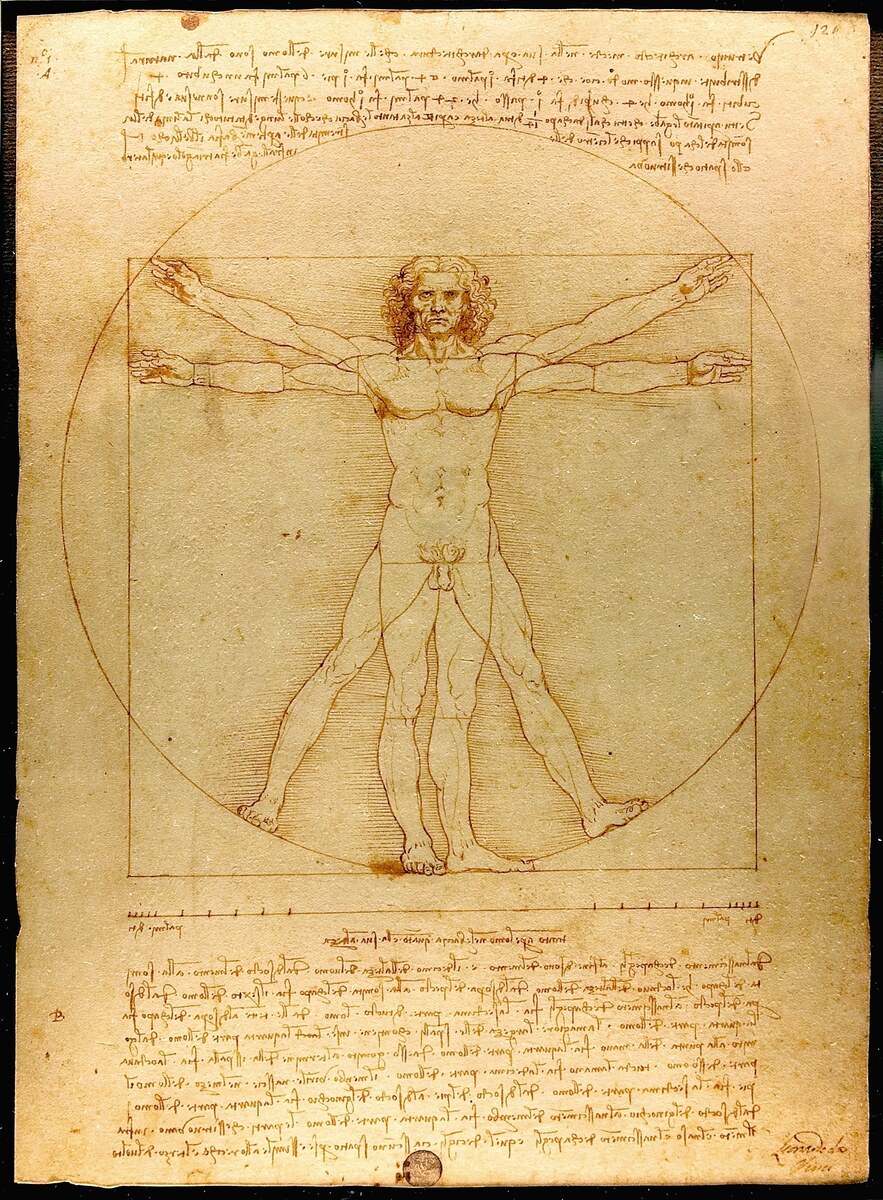
as function. The Vitruvian Man is the clearest statement of it — the body as a system
of exact, recoverable proportion, not myth.
That instinct — that form itself carries lawful, measurable structure — is the same one D'Arcy
Thompson will formalize mathematically four centuries later, and that this talk keeps returning to.
Leonardo da Vinci, Vitruvian Man, c. 1490 — the body as proportion, not myth.
11 / 49
Slide 12 · Alchemy and medicine
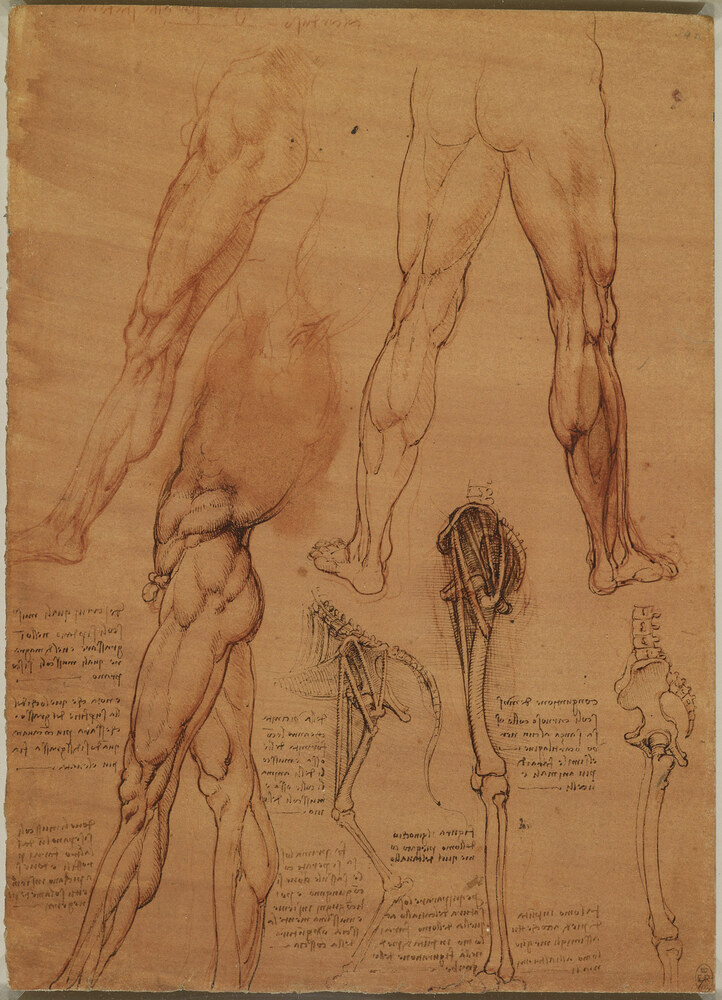
c. 1506–1511 · Leonardo da Vinci · Anatomical studies
Anatomy as evidence, not decoration.
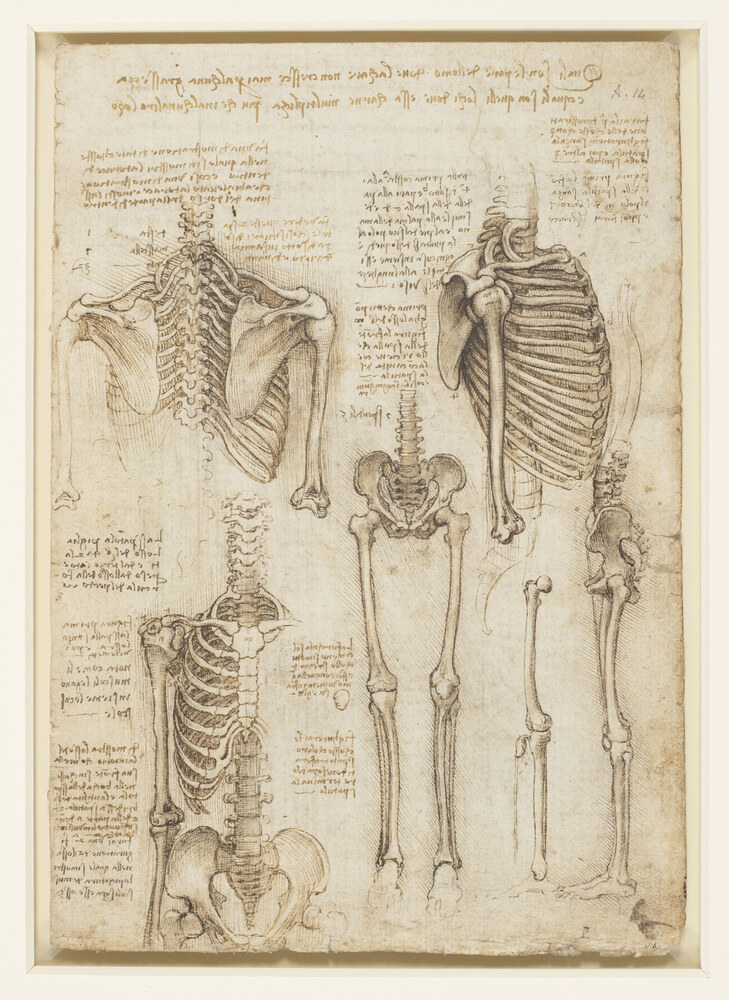
Leonardo turned drawing into a research tool. Working from direct dissection — knowledge
from bodies, not only books — he showed the body in layers (bones, muscles, tendons,
step-by-step) and from multiple views: section, elevation, and "exploded" arrangements.
These conventions now feel natural in medical illustration — one reason his drawings still look
modern. Making the body legible in three dimensions is the precondition for asking what
makes it work.
The skeleton · c. 1510–11
Leg muscles & bones · c. 1506–08
12 / 49
Slide 13 · Alchemy and medicine
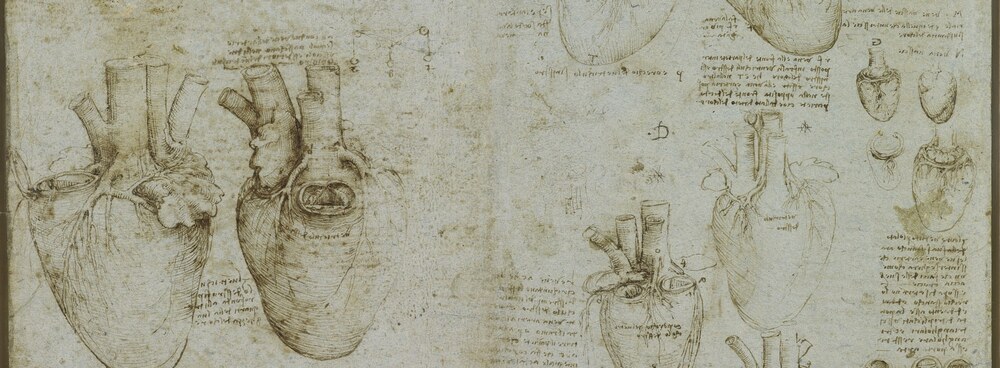
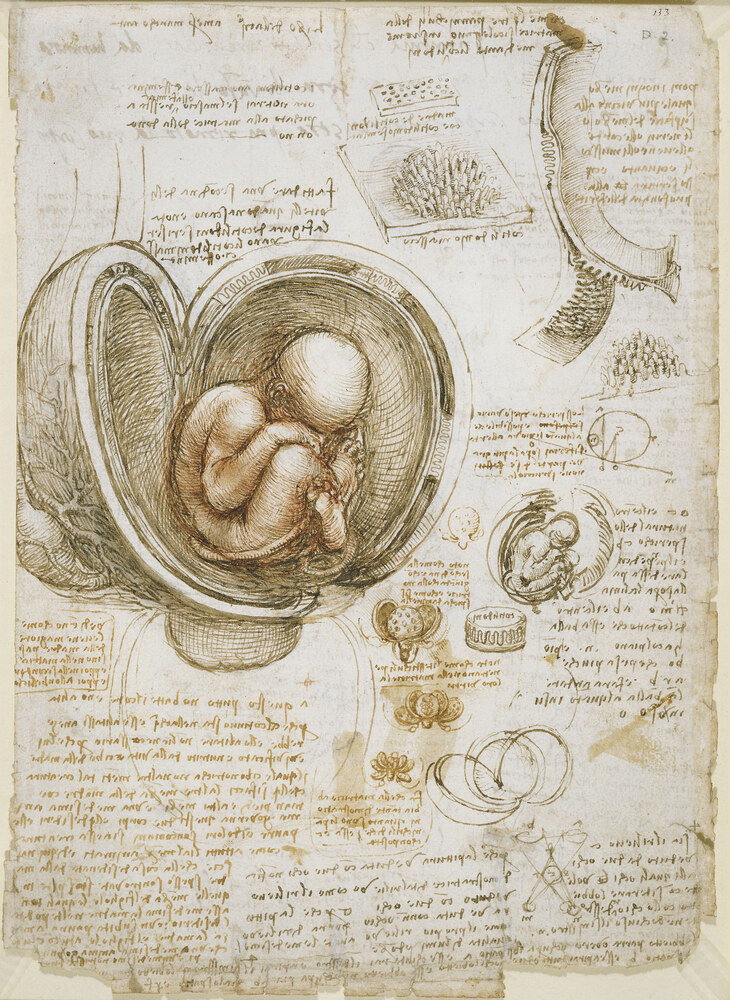
c. 1510–1513 · Leonardo da Vinci · Heart & embryo studies
From form to function: heart, fetus, legacy.
Leonardo was strongest when a drawing explained how the body works, not just how it looks.
He described the heart's chambers and valves with notable accuracy and grasped it as a
one-way pump; his fetal studies made gestation visually concrete — while still mixing human
observation with animal evidence.
Because the notebooks stayed unpublished until the late 1800s, their immediate medical impact was
limited — but their visual logic anticipated modern anatomical illustration, and the heart-as-pump
instinct points straight at Harvey.
The heart · c. 1511–13
Fetus in the womb · c. 1510–11
13 / 49
Slide 14 · Alchemy and medicine
1493–1541 · Paracelsus
Paracelsus: the body as a chemical microcosm.
Paracelsus moved healing from general balance toward targeted remedies — substances, doses,
thresholds. He still belonged to a magical and theological world, but he pushed medicine toward
chemical intervention: not only rebalancing humors, but attacking a disease directly.
His framing matters for what follows: bioelectricity also deals in thresholds — too much, too
little, wrong place, wrong timing — and cells behave differently depending on where they land.
Portrait of Paracelsus — physician-alchemist, sword marked "AZOTH."
14 / 49
Slide 15 · Alchemy and medicine
c. 1538 · Paracelsus · sola dosis facit venenum
"The dose makes the poison."
Paracelsus's most durable idea: nothing is simply "medicine" or "poison." The same substance
heals at one dose and harms at another. Effect depends on amount — a threshold, a window, a
curve — which is why he is often called the father of toxicology.
It is a fundamentally quantitative way to think about the body: not what a thing is,
but how much, where, and when. Bioelectricity obeys the same logic — the right voltage in the right
place regenerates; the wrong level does nothing, or drives cancer.
The therapeutic window — the same substance moving from too little, to remedy, to poison.
— / —
Slide 15 · Alchemy and medicine
~1300–1650 · what the alchemists were actually reaching for
Alchemy's real inheritance: transmutation of form, not metal.
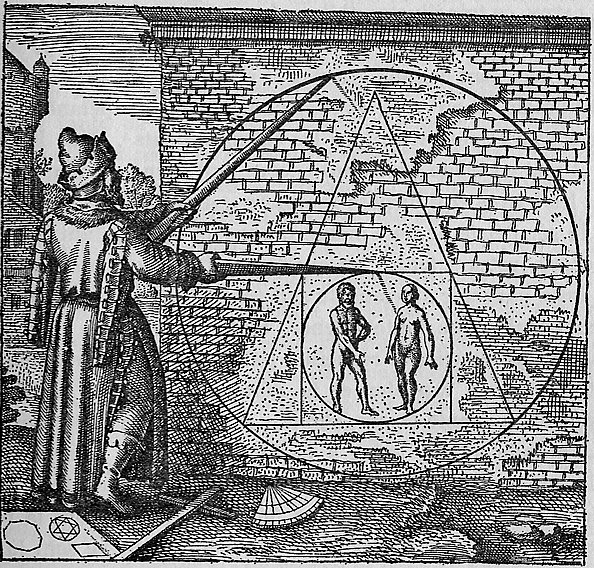
Maier, Atalanta Fugiens 21, 1617 — the "squared circle."
Strip away the gold-making and one ambition survives: a hidden principle guides matter into
its proper shape — and a skilled hand could redirect it. Alchemy failed on metal; bioelectricity
delivered on form.
1 · Transmutation → recompiling the body
Levin's lab turns one anatomy into another — two-headed planaria, xenobots — by editing
voltage, not genes.
2 · The archeus → a field you can read
Paracelsus's inner shaping force becomes Levin's bioelectric Vmem — a real,
instrumentable field.
15 / 49
Slide 15 · Alchemy and medicine
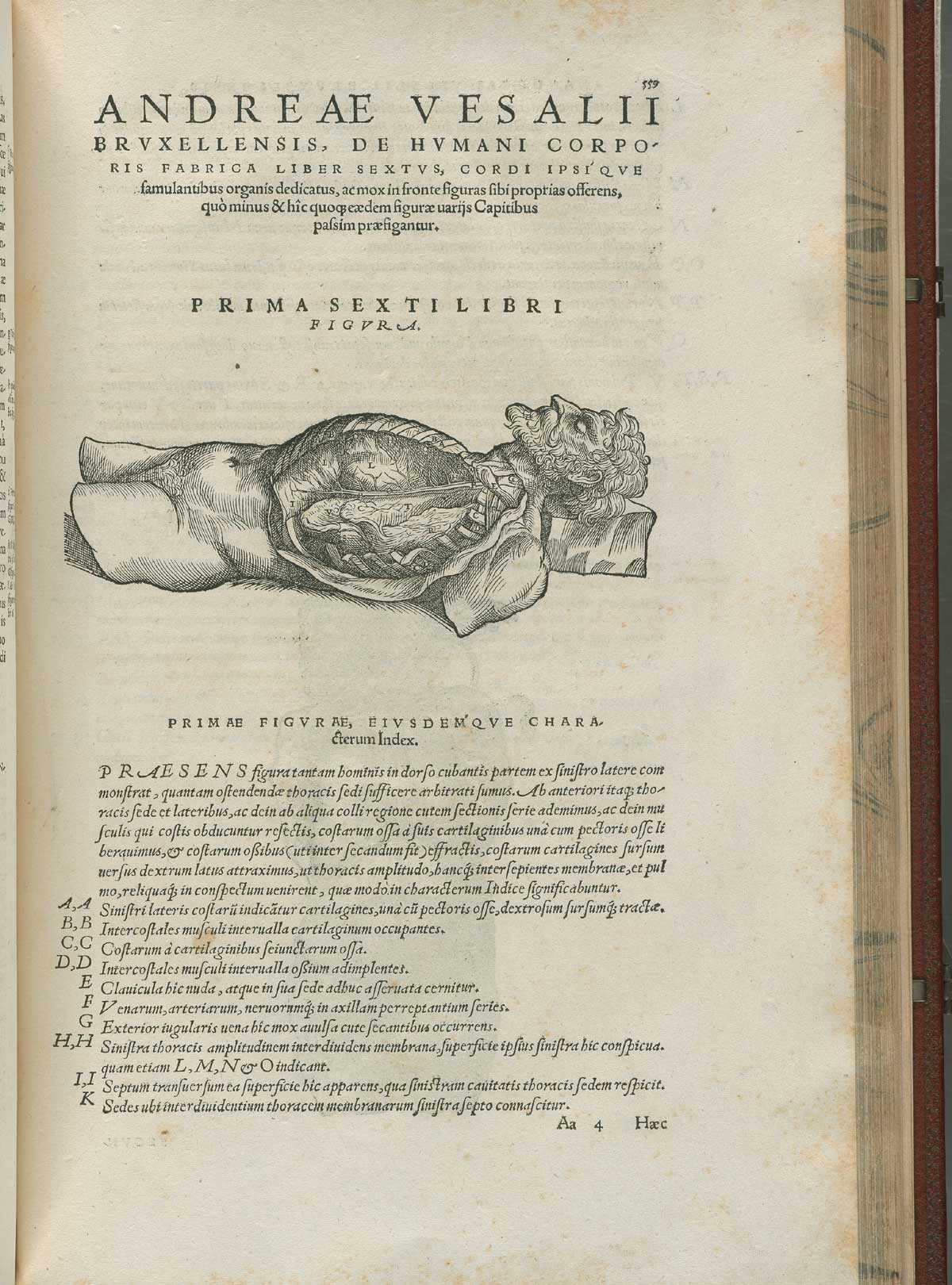
1543 · Andreas Vesalius, De Humani Corporis Fabrica
Vesalius replaced inherited authority with the dissected body.
For 1,300 years, anatomy was taught from Galen's texts — largely based on animal dissection, since
human dissection was rare. Vesalius dissected human cadavers himself and found hundreds of
discrepancies. De Humani Corporis Fabrica corrected the map of the body from direct
observation, not inherited authority.
It's a small methodological shift with huge consequences: once anatomy is settled by looking, not
citing, every subsequent physiological claim — including electrical ones — has to earn its place
by the same standard.
De Humani Corporis Fabrica, 1543 — an opened thoracic cavity, drawn from direct dissection.
15 / 49
Slide 16 · Alchemy and medicine
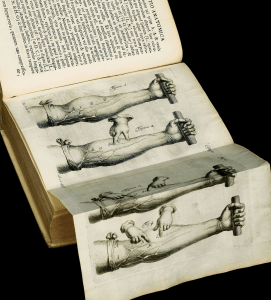
1628 · William Harvey, De Motu Cordis
Harvey showed the body runs on a closed, pumped system.
Galen taught that blood was continuously produced by the liver and consumed by the tissues.
Harvey calculated that the heart pumps far more blood per hour than the body could possibly
make — so it had to be the same blood, recirculating through a closed loop, driven by the
heart as a mechanical pump. He proved it with ligature experiments on living arms — described
in careful prose, building on his teacher Fabricius's discovery of the venous valves.
A quantitative argument — flow rate, not philosophy — settles a 1,400-year-old question. That's
the exact move bioelectricity researchers make next: measure the signal, don't just theorize it.
Forearm ligature experiment demonstrating one-way venous valves — Harvey's argument in De Motu Cordis, 1628 (illustration from a later edition).
16 / 49
Slide 17 · Alchemy and medicine
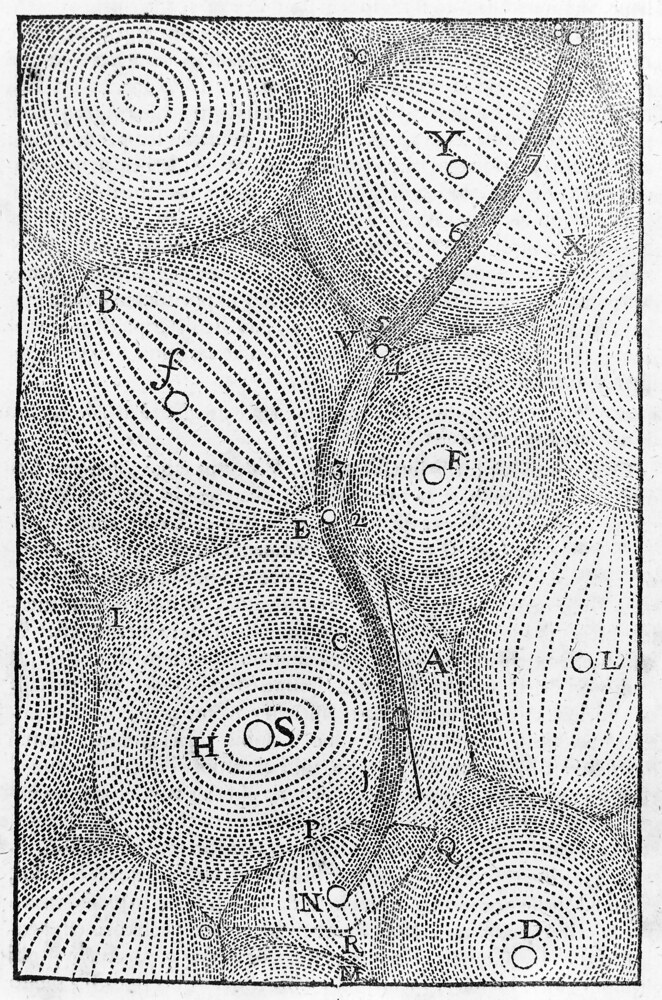
1644 · René Descartes, Principia Philosophiae
Descartes: nature as matter, governed by lawful motion.
Descartes helped shift natural philosophy away from hidden qualities and purposes. He argued
the nature of matter "consists ... simply in its being extended in length, breadth and depth" —
body as extension, change as motion, governed by laws that could be studied systematically.
"The nature of matter … consists … simply in its being extended in length, breadth and depth."
Principles of Philosophy, Part II, §4; laws of nature developed at §§36–37. Nature becomes
a lawful physical system — something that can be modeled, measured, and explained mechanically.
Descartes's system of vortices, Principia Philosophiae, 1644 — the universe explained through moving matter, not Aristotelian purpose.
17 / 49
Slide 18 · Alchemy and medicine
1664 (posthumous) · René Descartes, Treatise on Man
Descartes: nerves as mechanical communication lines.
Descartes did not draw the first anatomical nerve map — Galen and Vesalius had already described
and illustrated nerves. What he did was newer: he imagined nerves as hollow tubes carrying
"animal spirits," with the heart as a spring and the brain's cavities as outlets — the body as a
physical communication system.
"The nerves … may very well be compared to the pipes."
Treatise on Man. The mechanism was wrong — no fluid runs through the nerves — but the move
was profound: signalling as plumbing, not soul. Swap "fluid pressure" for "electrical potential"
and this is nearly the right question, asked 150 years before anyone could test it.
Descartes's nervous system as hydraulic machinery — brain, nerves, and pineal gland routing "animal spirits," De Homine, 1662.
18 / 49
Slide 19 · Alchemy and medicine
1664 (posthumous) · René Descartes, Treatise on Man
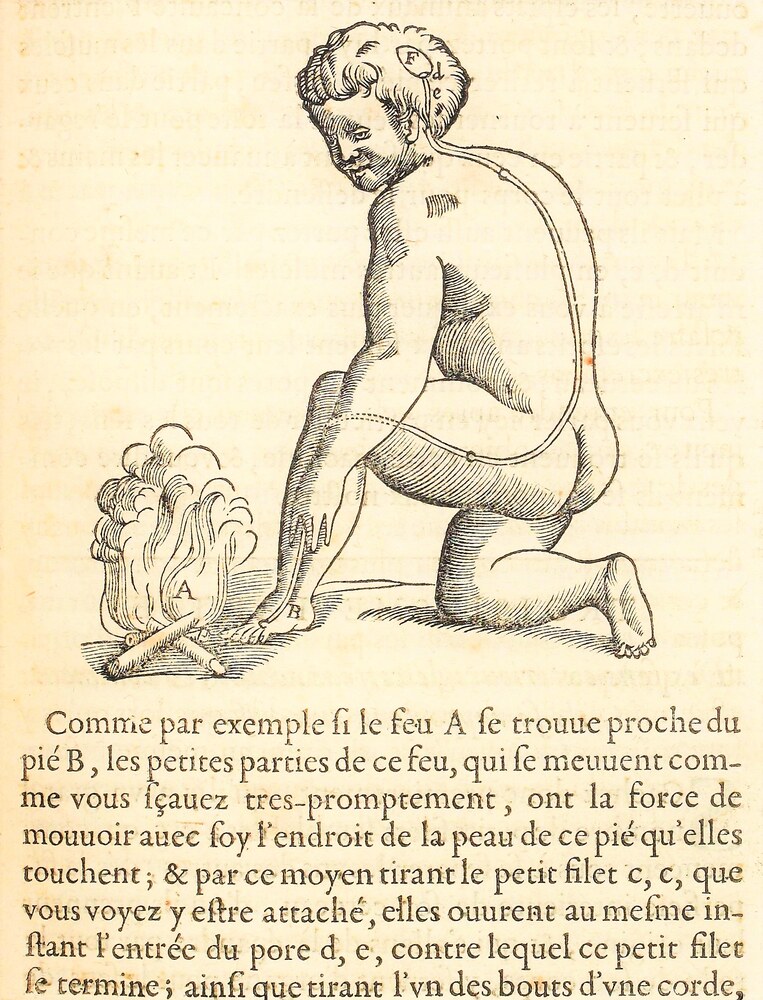
The proto-reflex: pain without conscious choice.
Heat near the foot pulls a tiny thread, opens a pore in the brain, and sends animal spirits into
the muscles that withdraw the foot — all before conscious reasoning gets involved. Descartes gave
one of the first mechanical accounts of what we now call reflex action.
"By pulling one end of a cord, you … ring a bell."
Treatise on Man. The body is not a passive container for the soul — it has automatic
mechanisms of sensation, pain, and defence. The Becker Medical Library describes the Treatise
of Man as the first European textbook on physiology, containing a statement resembling the
modern concept of reflex action.
Descartes, Traité de l'homme, 1664 — the chain students can read at a glance: fire → skin/nerve → brain → animal spirits → muscle.
19 / 49
The cautionary bridge
1778–1784 · Franz Anton Mesmer
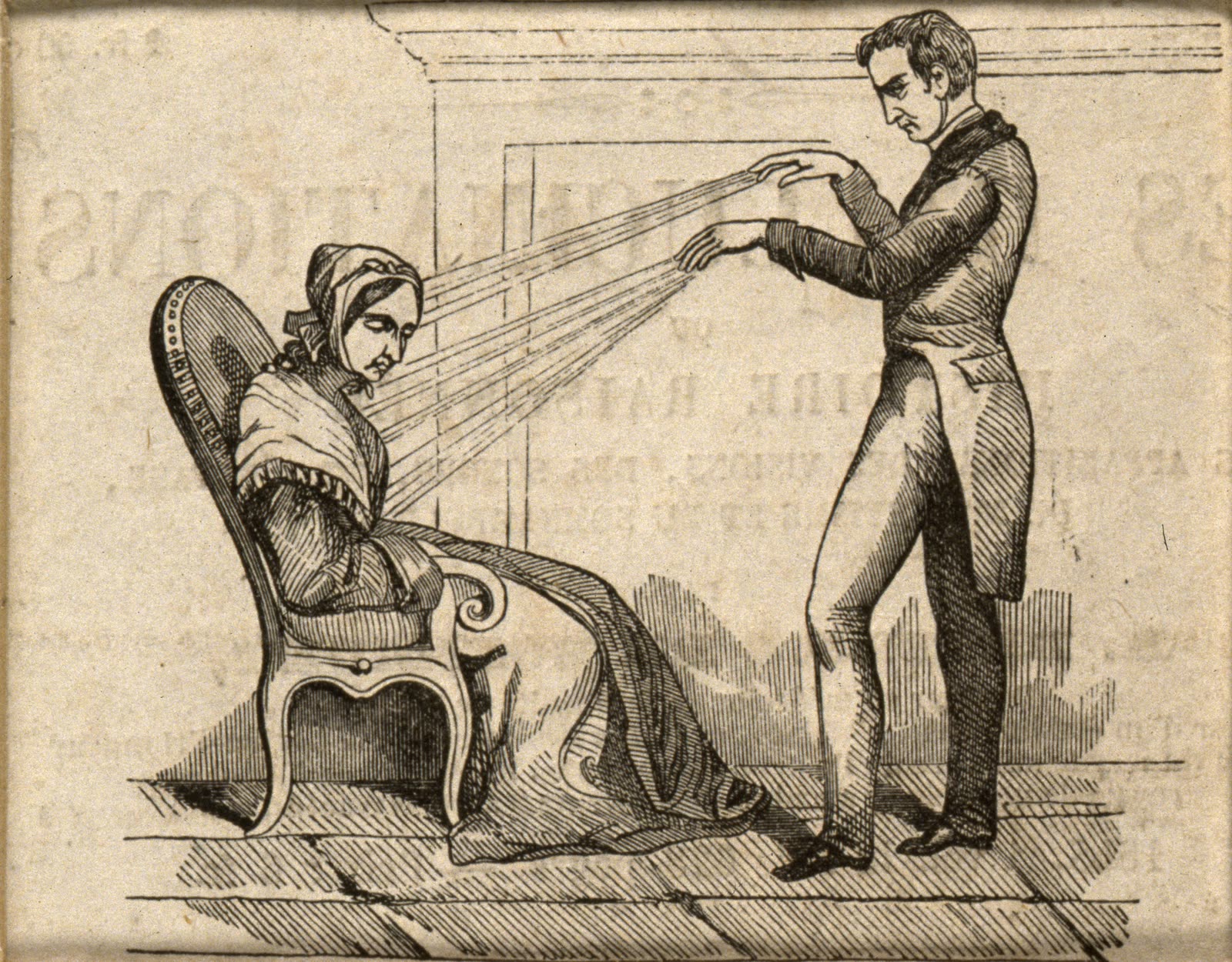
Mesmer's "animal magnetism": a healing craze meets the first blinded trial.
Mesmer claimed an invisible bodily fluid — animal magnetism — whose blockage caused disease
and whose redirection cured it. Paris salons filled with patients gripping iron rods around his
magnetized baquet. Patients convulsed, wept — and often improved.
In 1784 a royal commission — Benjamin Franklin, Lavoisier, Guillotin — ran what is arguably history's
first blinded, placebo-controlled trial: blindfolded patients responded to where they believed
the magnetism was, not where it was. The fluid didn't exist; the healing was imagination.
"The imagination without the magnetism produces convulsions… the magnetism without the imagination produces nothing." — Franklin commission, 1784
A mesmerist at work. Wellcome Collection, public domain.
Slide 20 · The pivot
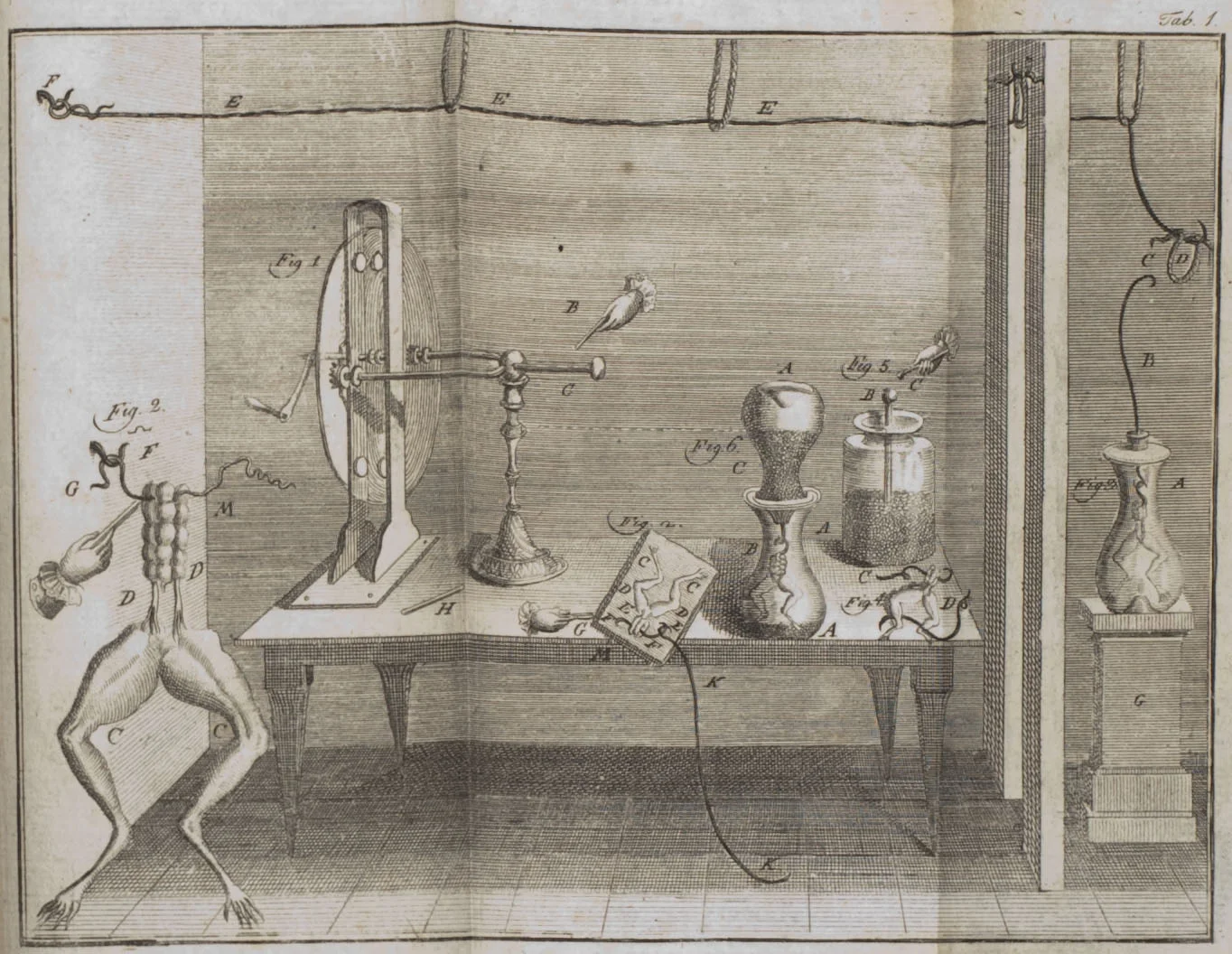
1780s · Luigi Galvani
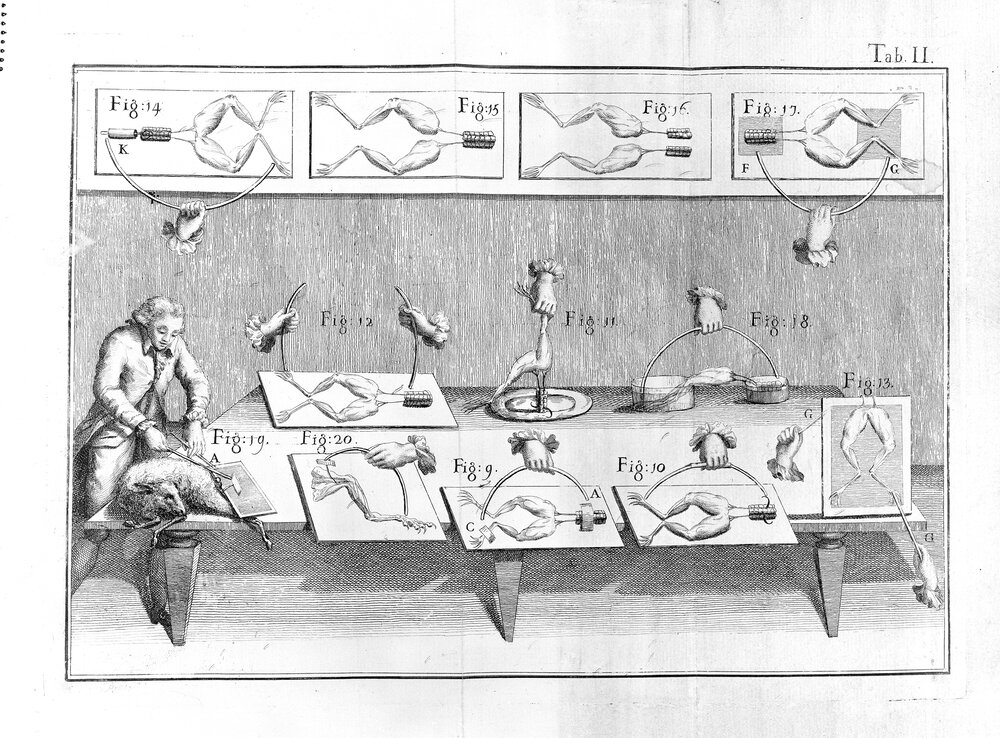
Galvani: the hidden force becomes experimental.
This is the pivot. For two thousand years, the force animating the body was philosophical —
humors, elements, proportion. Galvani's twitching frog leg made it measurable: an
experimental electrical phenomenon, not a hidden vital force.
"The question is no longer only 'What hidden force animates the body?' but 'Can we measure it, manipulate it, and understand what it does?'"
Plate from Galvani's De viribus electricitatis in motu musculari, 1791.
20 / 49
The spectacle
1803 · Giovanni Aldini
Aldini electrifies the dead — and literature gets Frankenstein.
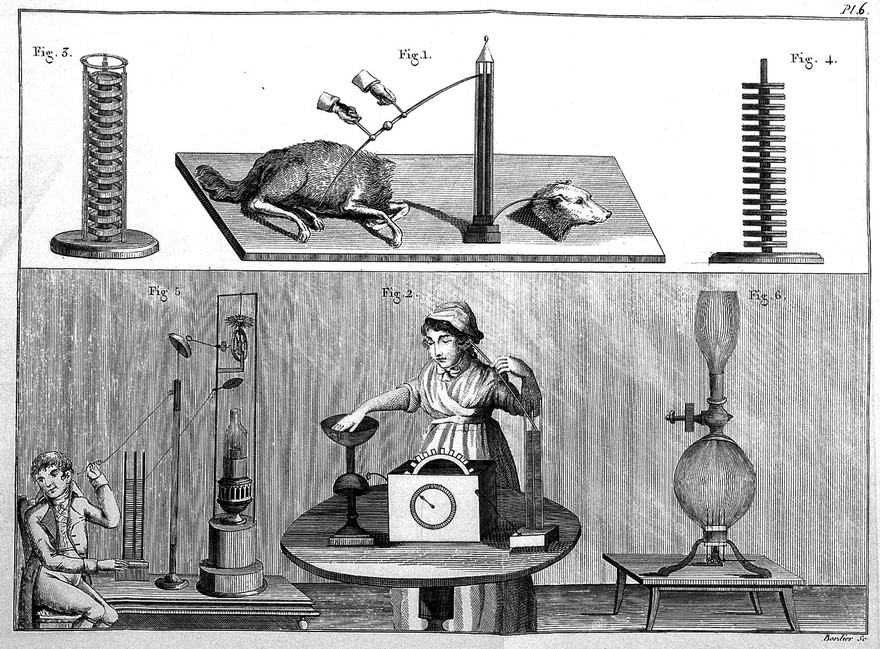
Galvani's nephew took the frog-leg result on tour. In London, 1803, Aldini applied a voltaic
pile to the corpse of the executed murderer George Forster: the jaw clenched, an eye opened,
a fist rose. Newspapers asked whether the dead could be revived.
Fifteen years later Mary Shelley — who knew these demonstrations from the scientific gossip of her
circle — published Frankenstein. The idea that electricity is the animating principle of life
entered popular culture a century before anyone could measure a membrane potential.
"Perhaps a corpse would be re-animated; galvanism had given token of such things." — Mary Shelley, 1831 introduction to Frankenstein
Plate from Aldini's Essai… sur le galvanisme, 1804. Wellcome Collection.
Slide 21 · Want to go deeper?
Live SEMF seminars · online · bioelectricitycourse.com
The Bioelectric Code of Life — two live seminars.
If any of what follows lands, two SEMF seminars go much deeper — from the mechanisms and philosophy of the bioelectric code to its clinical frontier in wound healing, cancer, and regeneration. bioelectricitycourse.com
Bioelectric Code of Life7 Mar 2026 · mechanism · philosophy · frontier
Joel Dietz
MIT · CIMC
Michael Levin
Tufts · Wyss
Emmett Shear
Softmax
Derek Lomas
TU Delft
Adam Goldstein
Hum Labs
Adam Safron
Tufts Allen Ctr
Patrick McMillen
Tufts
Wesley Clawson
Tufts
Bioelectricity & Human Healing15 Aug 2026 · wound healing · cancer · regeneration
Min Zhao
UC Davis
Michael Levin
Tufts
Saverio Gentile
MUSC
Joel Dietz
Bioelec. Nexus
Nirosha Murugan
Algoma · Allen Ctr
21 / 49
Slide 22 · Mapping the literature
Tool · ProbKnow · probknow.com
The field has grown faster than any one researcher can track.
ProbKnow is a probabilistic knowledge graph for bioelectricity research — papers,
researchers, organizations and concepts, all linked by inferred relationships.
Surfaces hidden connections between labs, papers and ideas the citation graph misses.
Lets a non-expert ask "who works on planarian regeneration AND uses GEVIs?" and get a navigable answer.
Updates as new papers land, so the map stays current as the field accelerates.
ProbKnow knowledge graph · live exploration of the bioelectricity literature.
22 / 49
Slide 23 · Key terms in Michael Levin
Glossary · hover any card for the definition
Six words that do most of the heavy lifting.
Basal Cognition
Levin · Lyon · 2020
Minimal goal-directed problem-solving in non-neural cells, tissues, and even single-celled organisms — intelligence without brains.
hover
Morphogenesis
D'Arcy Thompson · 1917
The process by which a developing organism builds its three-dimensional body shape from a single fertilized cell.
hover
Anatomical Homeostasis
Levin lab · 2010s
Active maintenance and restoration of the correct body structure — the regulator that knows when to stop regenerating.
hover
Anthrobots
Gumuskaya · Levin · 2024
Self-assembling motile spheroids built from human tracheal cells — same idea as xenobots, human substrate, no genetic modification.
hover
Xenobots
Kriegman · Levin · 2020
Programmable living machines built from frog (Xenopus) skin cells — body shape designed in silico, assembled from biological parts.
hover
Morphospace
Raup · 1966
The abstract space of all possible body plans — most points are empty; evolution and bioelectricity navigate it.
hover
23 / 49
Slide 24 · How we discovered cells run on electricity
1780s–1952 · Galvani → Hodgkin & Huxley
It took ~170 years to be sure cells generate their own voltage.
Five experiments settled the basic question — do cells produce electricity at all? Hover any card for the detail.
1780–91
Galvani
hover
Luigi Galvani — frog leg twitches when touched by a bimetal arc. Calls it animal electricity and proposes the nervous system itself generates it, conducting intrinsic electricity from brain to muscle.
1800
Volta
hover
Alessandro Volta — argues the current comes from the dissimilar metals, not the frog. Builds the voltaic pile (battery) to prove it.
1840s–50s
du Bois-Reymond
hover
Emil du Bois-Reymond — sensitive galvanometers detect electrical signals in nerve and muscle, including the "negative variation" later understood as the action potential. Galvani vindicated.
1902
Bernstein
hover
Julius Bernstein — membrane theory: cells are polarised because the membrane is selectively permeable to K⁺. Resting potential gets a mechanism.
1939–52
Hodgkin & Huxley
Nobel 1963 · hover
Hodgkin & Huxley — squid giant axon, voltage clamp, four ODEs that quantitatively predict the action potential. The mechanism becomes maths. Nobel 1963
Plate from Galvani's De Viribus Electricitatis (1791) · animated reconstruction of the bimetal-arc circuit closing.
24 / 49
Slide 25 · The thesis, 100 years early
1917
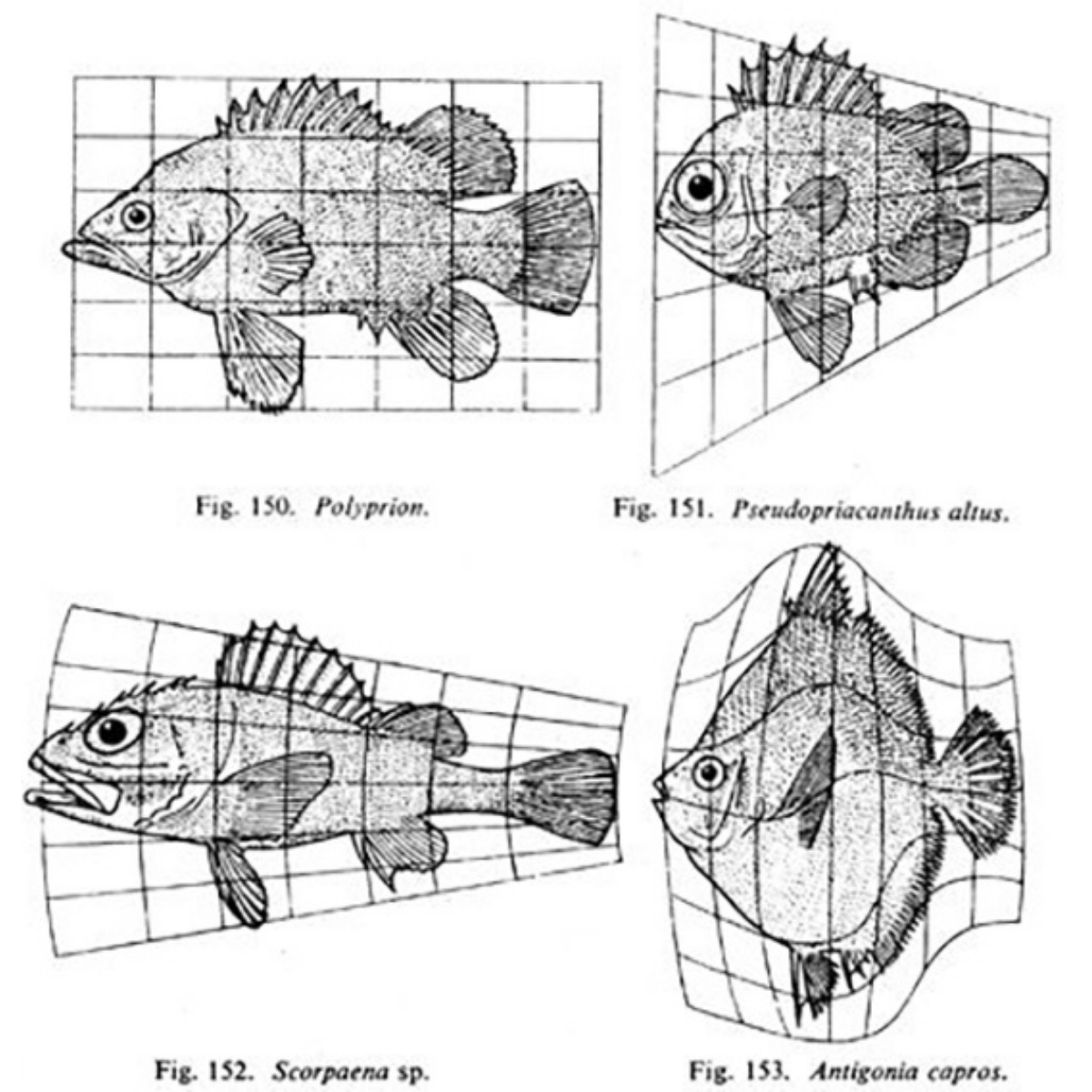
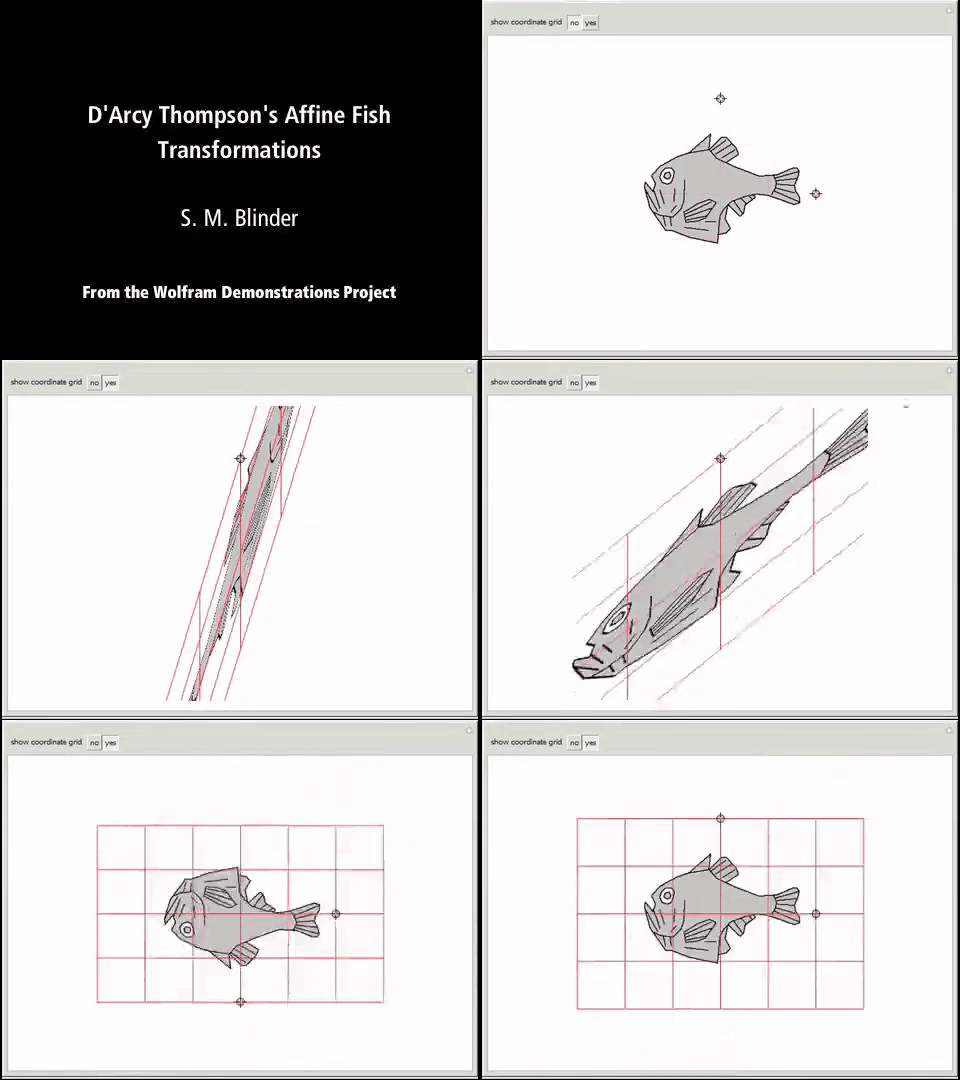
D'Arcy Thompson: form is geometry, not just inheritance.
In On Growth and Form, Thompson showed you could turn one species' body into another's by
warping a coordinate grid — not by changing the parts list.
That image is a conceptual precursor to bioelectricity research a century later: there is some
field, some tissue-scale instruction, that helps decide shape on top of the cellular
hardware.
The genome lists ingredients. Something else does the warping.
Original · On Growth and Form, 1917 · Figs. 150–153
Same idea, animated · Wolfram Demonstrations
25 / 49
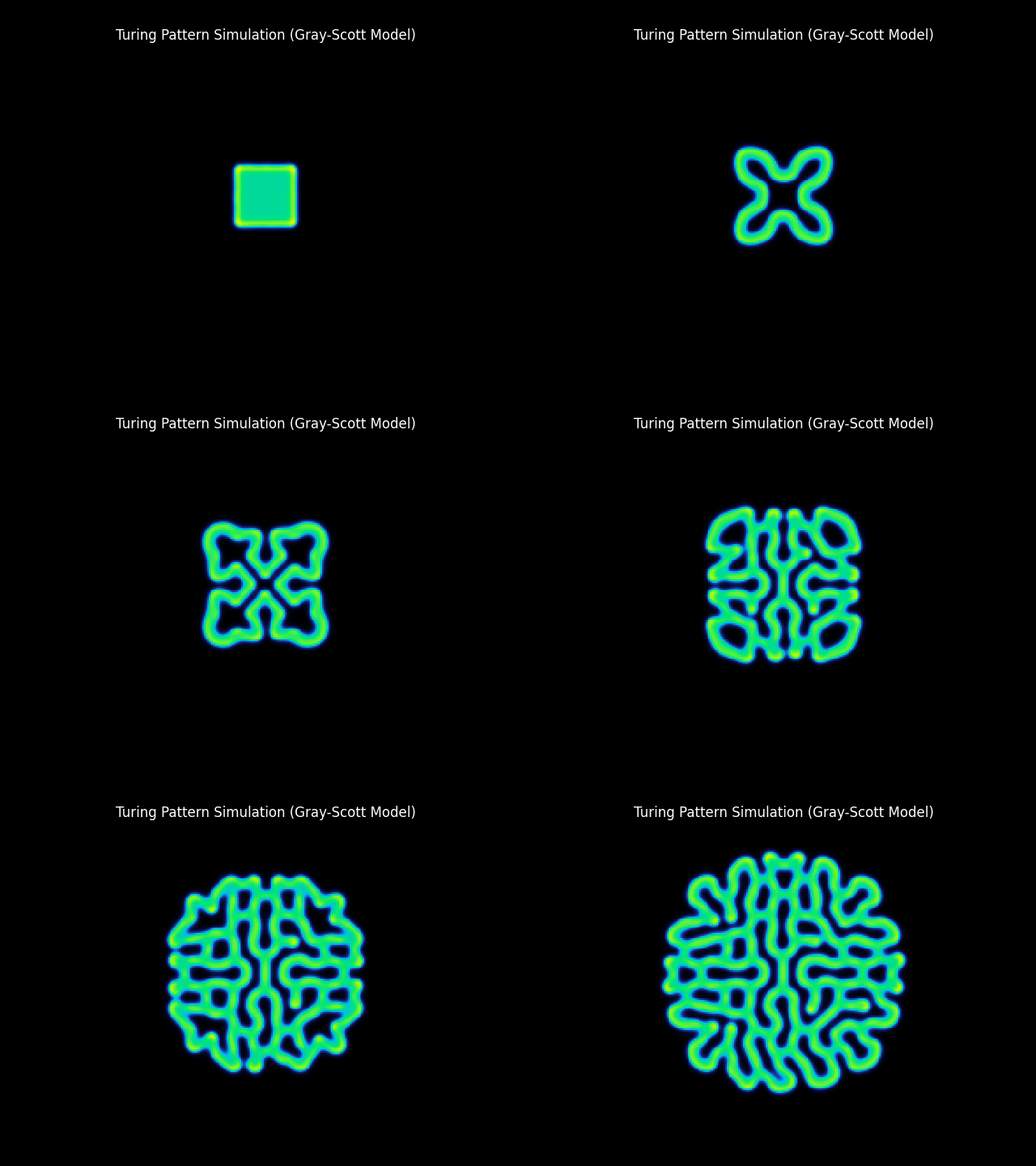
Slide 26 · Turing's reaction-diffusion
1952 · Alan Turing · The Chemical Basis of Morphogenesis
The math arrived 25 years before the biology.
In 1952, less than two years before his death, Turing showed that two diffusing chemicals with the right
nonlinear interaction can spontaneously break a uniform tissue into stable spatial
patterns — spots, stripes, waves. From nothing but the math.
Activator + inhibitor diffusing at different rates — the activator self-amplifies locally, the inhibitor diffuses faster and suppresses neighbours. A uniform field becomes a regular pattern.
Predicted patterns ~25–40 years before any biological mechanism was confirmed.
Vindicated in marine angelfish stripes (Kondo & Asai, Nature 1995), mouse digit spacing (Sheth et al., Science 2012), hair-follicle spacing (Sick et al., Science 2006), and fish skin pigmentation.
Gray-Scott reaction-diffusion simulation (activator V × inhibitor U, du=0.2 / dv=0.1, f=0.055 / k=0.062) — a noisy central seed self-organizes into Turing spots. Rendered from fractastical/morpholib · 1952-turing-morpho.py.
26 / 49
Slide 27 · The space of all possible bodies
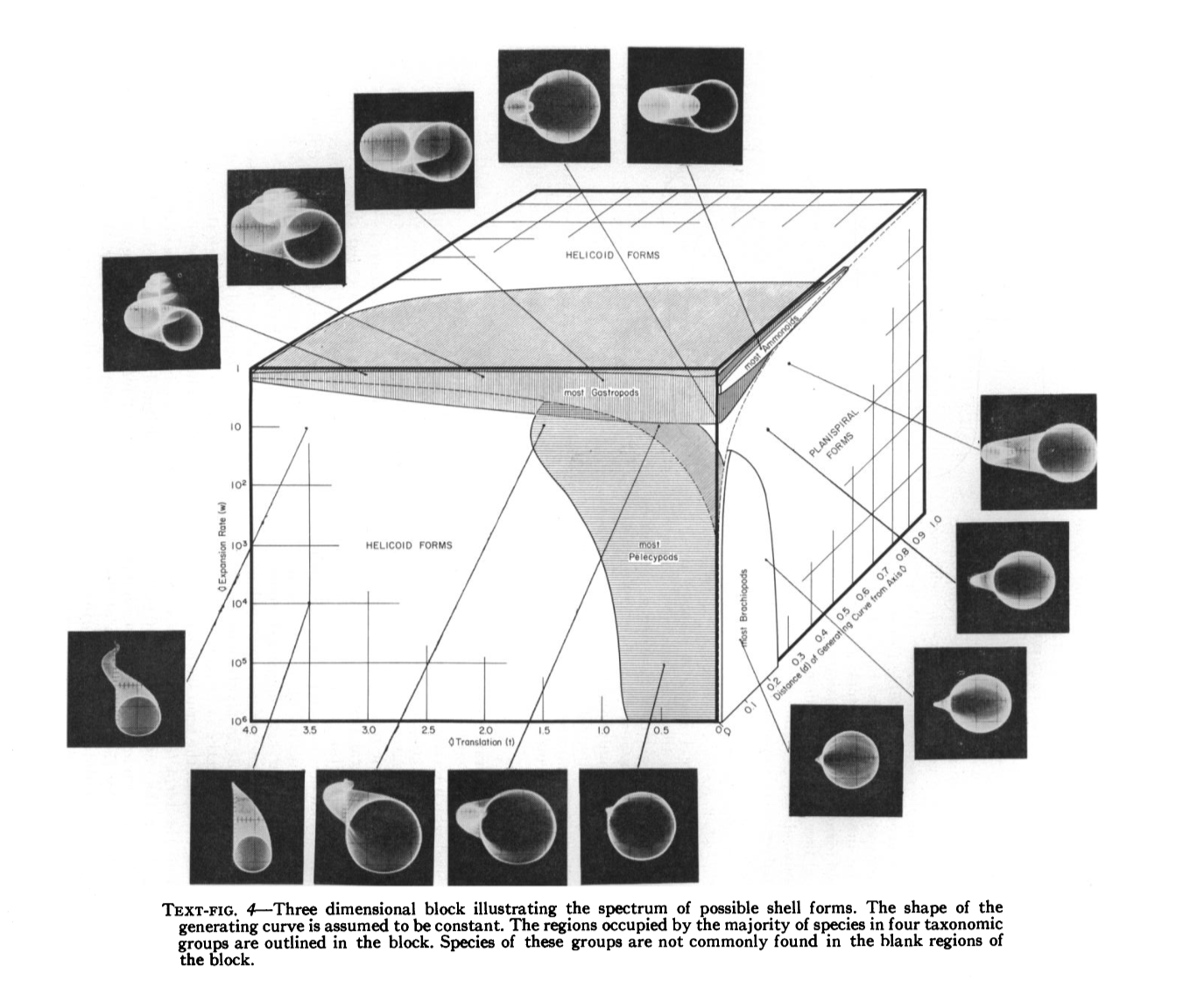
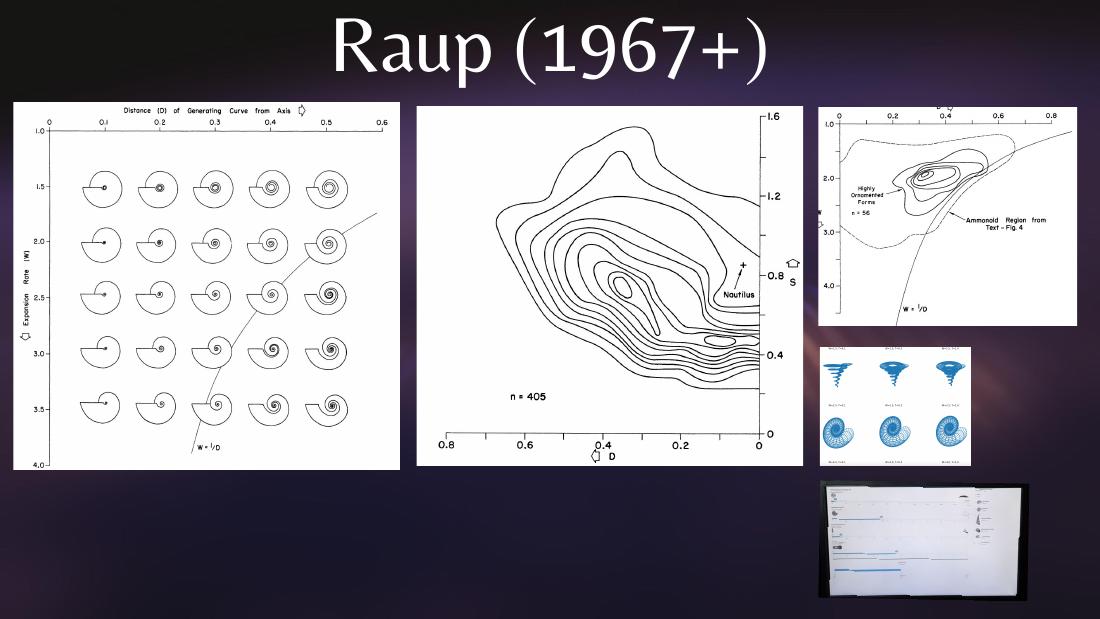
1966 · David Raup
If form is geometry, then there is a space of all forms — and most of it is empty.
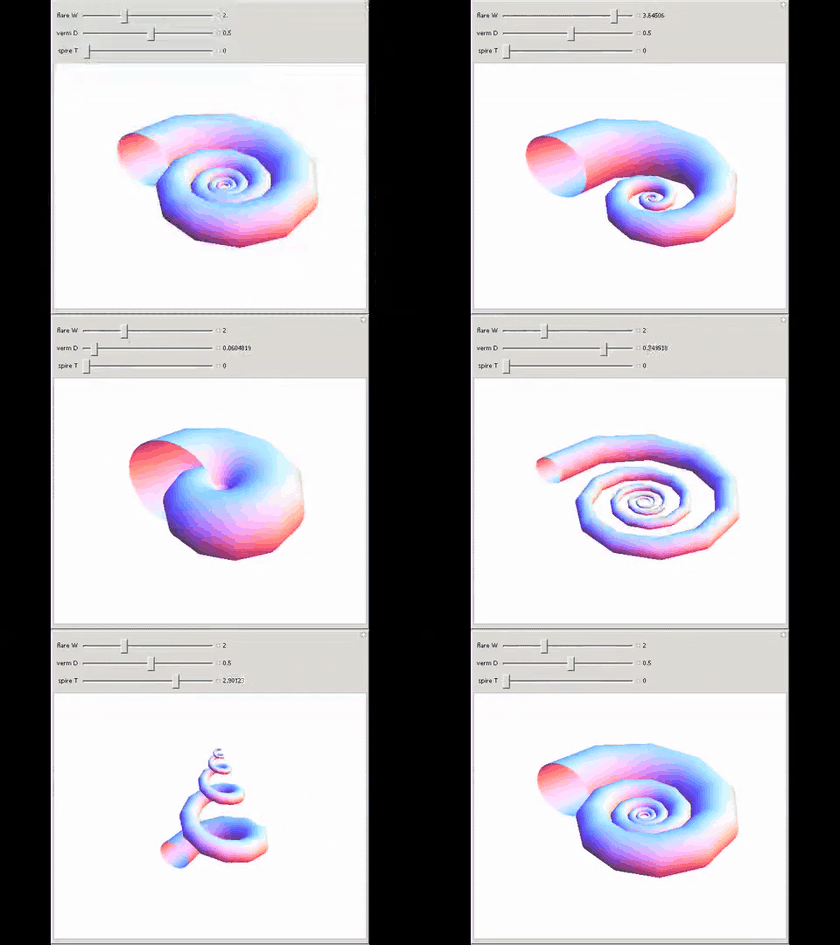
Raup parameterised gastropod shells with just three numbers — W (whorl expansion rate),
D (distance from the coiling axis), and T (translation rate along the axis). Sweep the
parameters and you generate the full theoretical morphospace of coiled shells.
The striking finding: sampled gastropod shells occupy only a small region of that space. Most of the
cube is geometrically possible but biologically unused.
Form lives in a space. Evolution and development pick a trajectory through it.
Raup 1966 · the original W × D × T cube
Raup 1967 · n=405 shell occupancy, W×D plane
Same parameters, animated · Wolfram
27 / 49
Slide 29 · The mechanism in 90 seconds
Primer · how bioelectricity actually works
Cells run on voltage — and they share it across tissue.
Three ingredients turn single-cell voltages into a tissue-scale instruction. Every result on the next five slides is a read or a write on this layer.
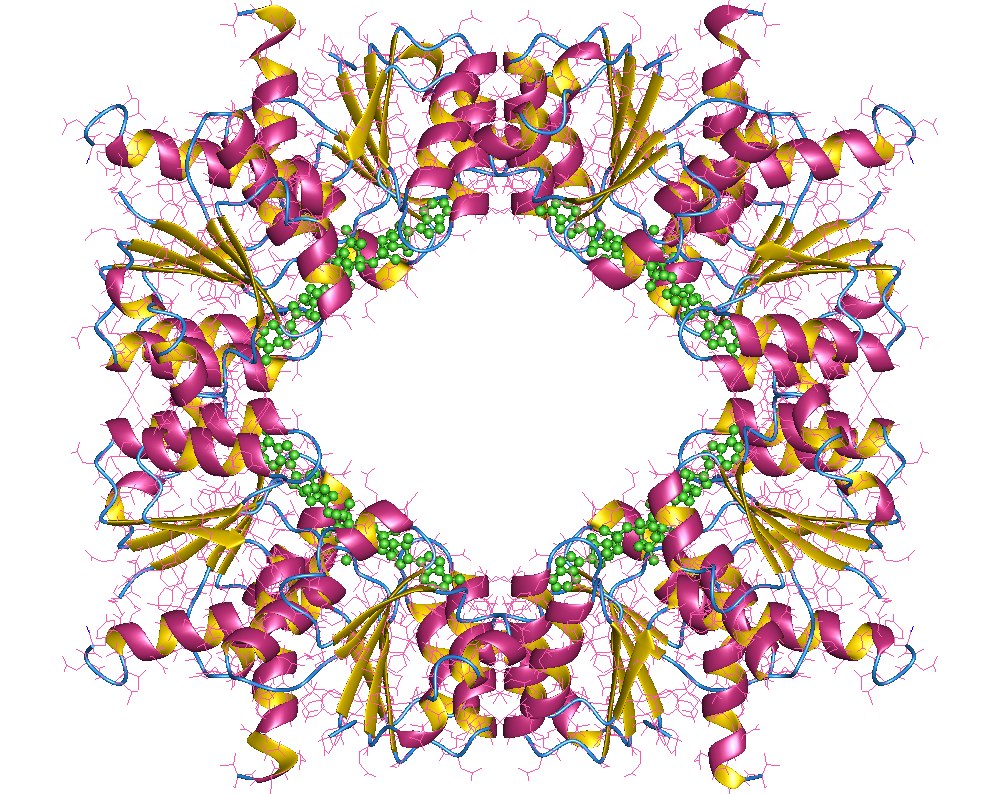
Ion pumps and channels (like this K⁺ channel) move K⁺, Na⁺ and Cl⁻ across the membrane. Net result: tens of millivolts (Vmem) across the membrane of every cell — not just neurons.
2
Cells share voltage via gap junctions
Gap junctions are direct ion channels between neighbouring cells. Patches settle into shared voltage states, building a tissue-scale bioelectric pattern over hours.
3
The pattern instructs anatomy
Vmem patterns can gate downstream gene expression. In several systems, induced patterns bias anatomical outcomes. Read with voltage dyes; write with channel openers/blockers.
29 / 49
Slide 30 · The computational mirror
2020–2021 · Mordvintsev, Randazzo, Niklasson, Levin · Distill · Google Research
The same answer, in silicon: local rules → global form.i
what's an NCA?
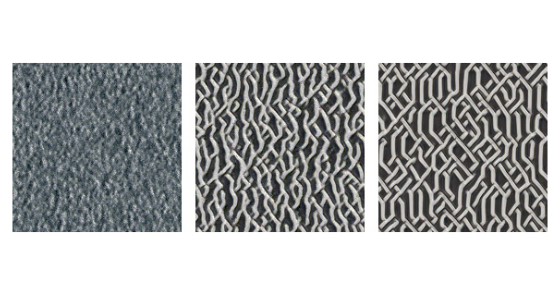
If Turing showed that local diffusion rules can spontaneously produce stable patterns, a recent line of work shows the same thing with learned local rules. Neural Cellular Automata are tiny neural networks where every "cell" runs the same update rule on its own state plus its neighbours. Train them, and they grow lizards from a single seed pixel, regenerate after damage, classify MNIST digits collectively, or self-organise complex textures — all from purely local interactions.
Growing NCA · Mordvintsev, Randazzo, Niklasson & Levin, Distill 2020 — live embed. Scroll inside the frame to see lizards grown from a single seed pixel and regenerated after damage.
Bioelectric Vmem patterns are doing the analog version of what NCAs do in silico — every cell runs the same local rule on its own membrane voltage + its neighbours' (gap-junction-coupled). Substrate differs (ion channels vs learned weights); the math is the same. Levin co-authors the Distill series.
30 / 49
Slide 31 · How we actually see voltage in tissue
Primer · the imaging toolkit
Four generations of probes for reading Vmem — from one cell to a whole-embryo map.
1
Microelectrodes & patch clamp
Hodgkin & Huxley, 1952 → Neher & Sakmann, 1976 (Nobel 1991). Impale or seal onto a single cell to read Vmem directly. Gold standard accuracy — but one cell at a time.
2
Vibrating probe (extracellular)
Jaffe & Nuccitelli, 1974. A platinum ball maps endogenous ion currents without touching cells — first window onto developmental bioelectricity.
3
Voltage-sensitive dyes (VSDs)
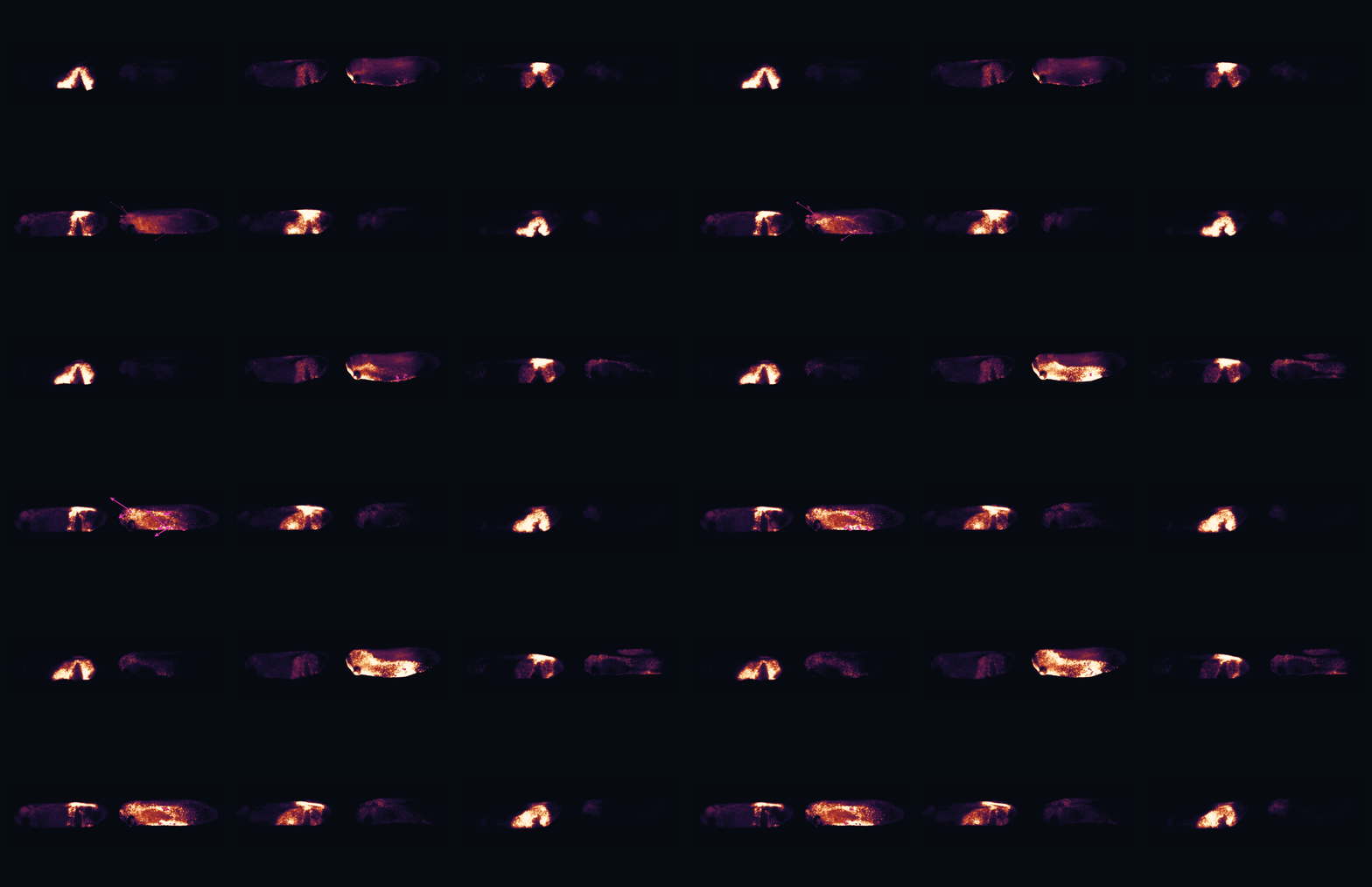
Cohen et al., 1973 → Adams & Levin, 2012. Fluorescent small molecules whose brightness tracks Vmem. CC2-DMPE + DiBAC4(3) used as complementary dyes — produced the "Face of a Frog" map on the next slide. → image at right.
4
Genetically encoded voltage indicators
ArcLight (2012) → ASAP → Archon → Voltron (2019). Fluorescent proteins expressed in chosen cells — voltage readout becomes cell-type specific and works in vivo.
Generation 3 in practice — Vmem map of Xenopus embryos imaged with complementary voltage-sensitive dyes.
Bright = depolarized · Dark = hyperpolarized. Levin Lab, Tufts University — CC-BY.
31 / 49
Slide 35 · First direct evidence
2011 · Vandenberg, Morrie & Adams · Levin lab
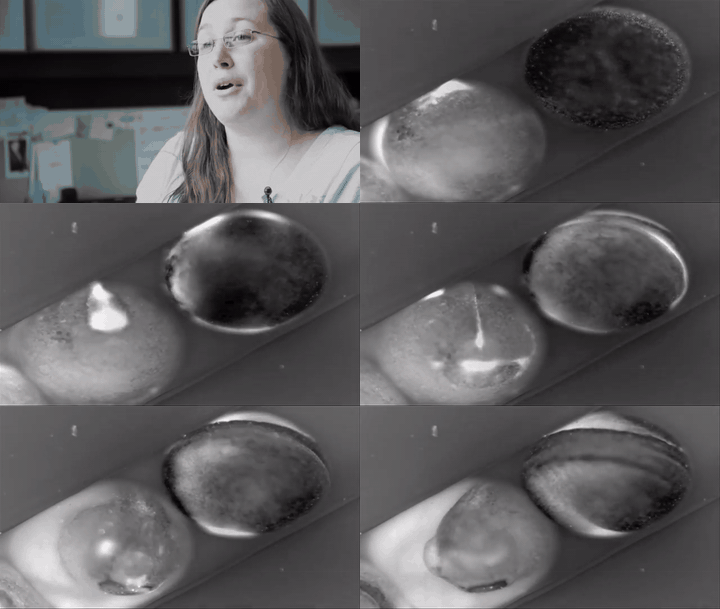
The face appears as a voltage map before any features form.
Using voltage-sensitive dye, the Levin lab imaged the surface of Xenopus
embryos as the head developed. Hyper- and depolarized regions pre-figured the eyes, mouth,
and nostrils — sometimes hours before the cells got there.
Disrupt the voltage pre-pattern and you get craniofacial mispatterning (colloquially the
"Picasso tadpole" phenotype) — features in the wrong places.
Bioelectric prepatterns predict and influence the craniofacial pattern that follows.
Voltage map · CC2-DMPE + DiBAC4(3)
Anatomy follows · brightfield time-lapse
Modern follow-up · 2026 · post-wound wave-vector flow
Imaging: Vandenberg, Morrie & Adams (2011), Dev. Dyn. — voltage-dye recordings by D. S. Adams, Levin Lab, Tufts University.
35 / 49
Slide 36 · The blueprint is rewritable
2010–17 · Oviedo, Beane, Durant, Levin et al.
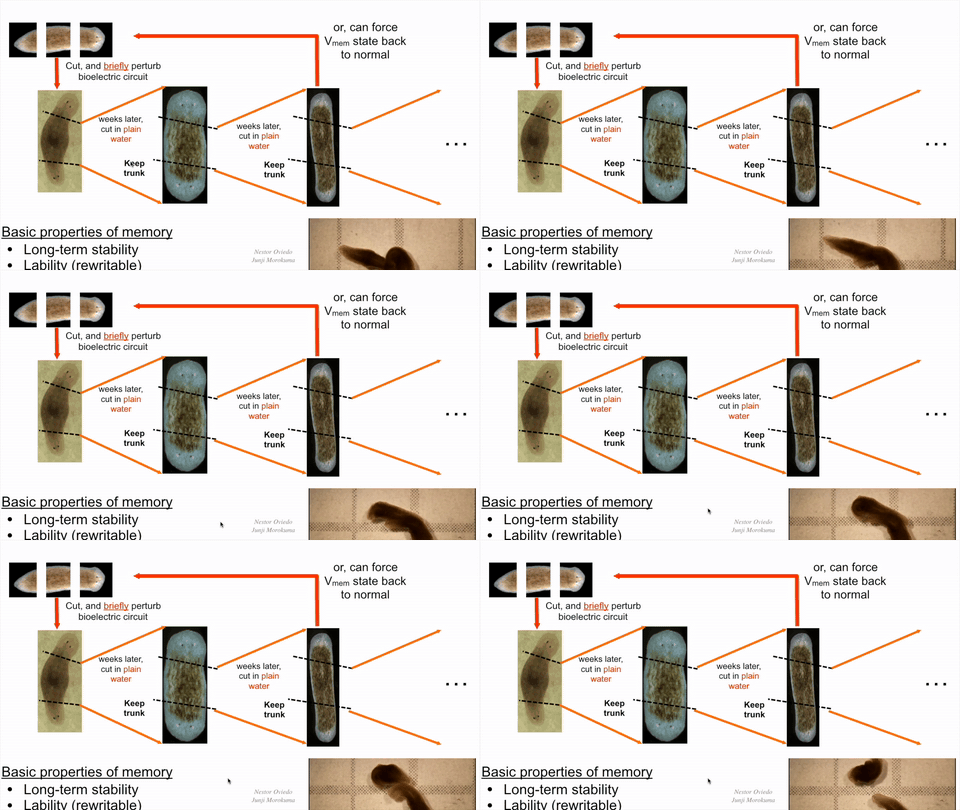
Two heads, same DNA — and the change persists.
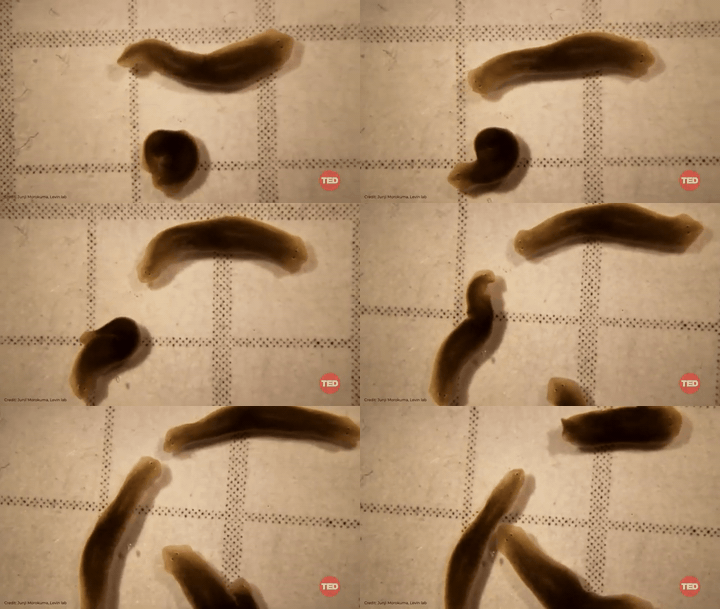
Cut a planarian flatworm in half and it normally regenerates one head and one tail. Briefly
perturb its bioelectric circuit before cutting and it can grow two heads instead — and
in Durant et al. (2017) that the altered head/tail target morphology is maintained across subsequent re-amputations via stable gap-junctional state changes,
even though the genome was never touched.
Body shape is partly stored in tissue-level voltage gradients (Vmem)
That store is rewritable and the rewrite can persist across regeneration
It behaves like pattern memory: long-term, addressable, content-specific
Live regeneration footage
The bioelectric edit · two-headed phenotype
Footage & two-headed phenotype: Levin Lab, Tufts University — Oviedo, Beane, Durant et al. (2010–17).
36 / 49
The forgotten experiment
1952 · Marsh & Beams
1952: an electric field reverses a regenerating body plan.
Gordon Marsh and H.W. Beams cut planaria into fragments and let them regenerate inside a DC
electric field. Weak fields: normal worms. Stronger opposing fields: two-headed worms.
Strongest: the body plan fully reversed — a head where the tail should be.
The anterior–posterior axis — the most basic decision a body makes — obeyed an imposed voltage
gradient, overriding whatever the tissue "remembered." Follow-up work showed the field itself,
not current density, carried the signal. Then the result sat largely forgotten for half a century.
The two-headed phenotype — first induced electrically in 1952, reproduced bioelectrically by the Levin Lab decades later.
Slide 38 · Same cells, different body
2020–21 · Kriegman, Blackiston, Bongard, Levin et al.
If form is partly software, you can recompile it — the xenobot.
Take embryonic skin cells from Xenopus laevis, remove the rest of the embryo, let the cells
reaggregate. They do not become frog skin.
They self-organise into a novel anatomy:
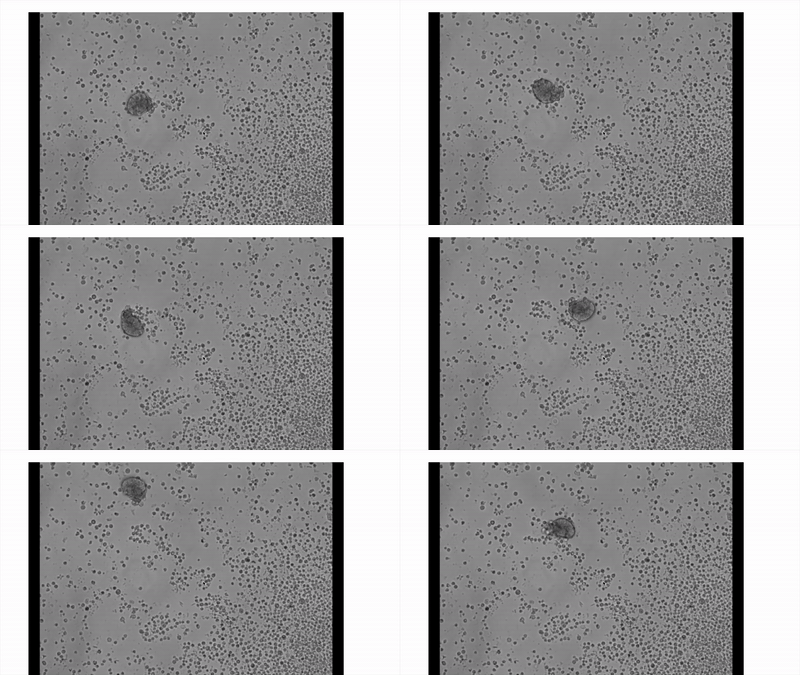
2020 — first xenobots, designed by an evolutionary algorithm and assembled by hand
(Kriegman et al., PNAS).
2021 — ciliated, self-propelling forms (Blackiston et al., Sci. Robotics) and
kinematic self-replication, where xenobots gather loose cells into new xenobots
(Kriegman et al., PNAS).
The genome doesn't encode a frog. It encodes capacity.
Xenobot navigating a field of loose cells. Source: M. Levin / Allen Discovery Center, Tufts.
38 / 49
Slide 39 · Built from human cells
2024 · Gumuskaya et al., Advanced Science
Anthrobots interact with human tissue in culture.
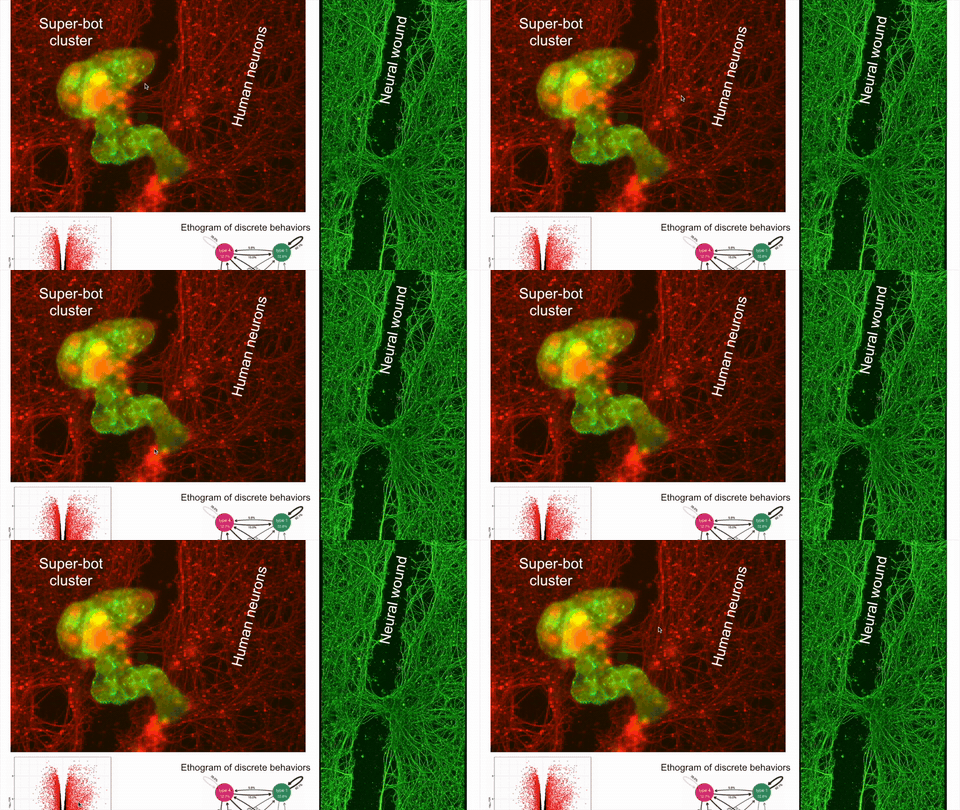
Made from adult human tracheal cells, anthrobots aggregate into "super-bot" clusters. In
in vitro assays they move across cultured human neurons, congregate near injuries, and
are associated with improved closure in neuronal-wound assays.
Because they're built from the same cells as the tissue around them, they natively share its
bioelectric and biochemical signalling — making them candidate research tools
for studying repair and tissue dynamics.
Super-bot cluster (green) on cultured human neurons (red), next to a neural wound. Source: Gumuskaya et al. (2024), Levin lab.
39 / 49
Slide 40 · The anatomical compiler
Murugan et al. (Levin lab) 2022 · Science Advances · 18-month follow-up in adult Xenopus laevis
Specify the anatomy. Let the cells compile it.
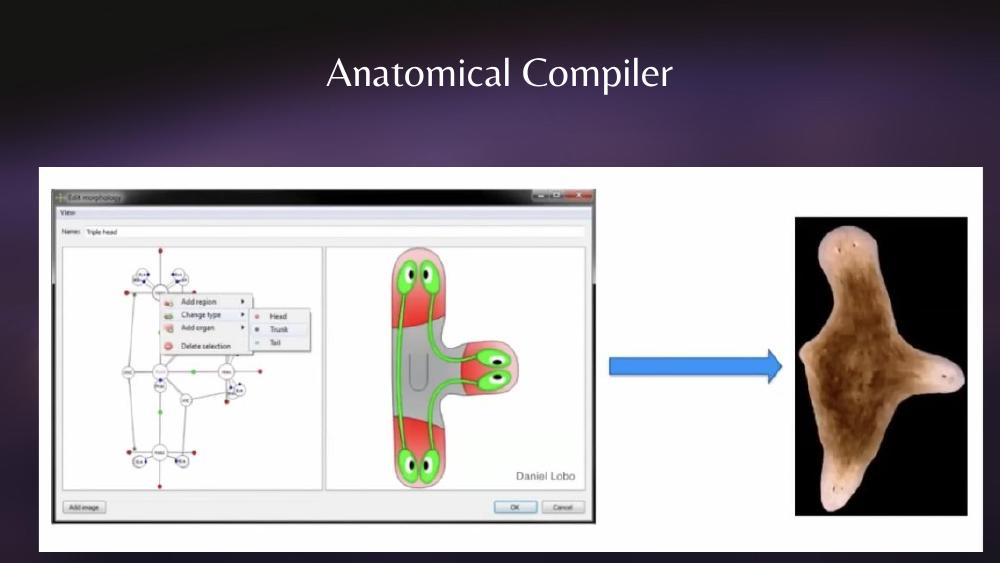
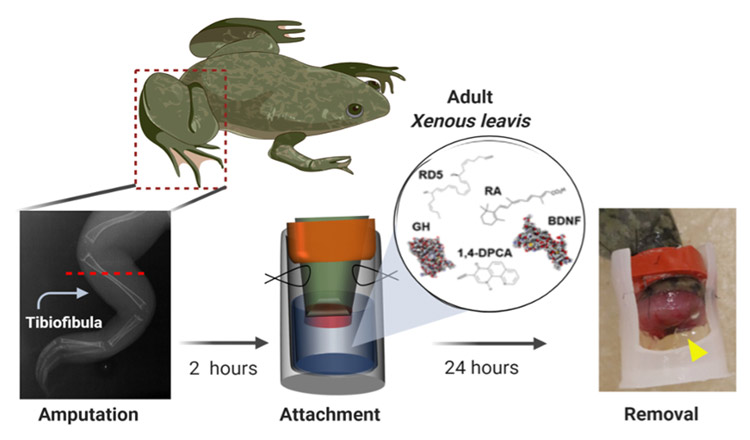
Stop micromanaging tissues; hand cells a target morphology and let them execute. Lobo & Levin built a literal compiler — a graphical model where you draw the body plan you want and the planarian regenerates it. A 24-hour drug cocktail in a wearable silicone BioDome then carries the same idea into adult Xenopus: 18 months of patterned limb outgrowth from one intervention.
● Compiler · Lobo & Levin · planarian regeneration model
Specify the target body plan in the editor (here: triple-head). The planarian regenerates that shape. The compiler turned "anatomical compiler" from metaphor into a literal piece of software.
● Compiler in vivo · Murugan et al. 2022 · BioDome on adult Xenopus
Adult X. laevis hindlimb amputation → silicone BioDome cap loaded with a 5-drug cocktail (BDNF · 1,4-DPCA · RD5 · GH · RA) → 24 h drug delivery → cap off. Bone, vasculature, innervation and motor function all show up over the next 18 months. Murugan et al., Sci. Adv. 2022.
40 / 49
Slide · Clinical frontier
1843 injury current → 2006 · Min Zhao, Nature · UC Davis
Wounds are batteries — and cells follow the field to close them.
Break an epithelium and the tissue's battery short-circuits: a steady wound current flows,
pointing at the injury. Min Zhao's lab showed cells read this field and migrate along it
(galvanotaxis) — and his 2006 Nature paper found the field can override every other
guidance cue, steering through PI3K/PTEN, the same machinery cancer mutates.
This is the most investable corner of bioelectricity today: the signal is measurable, the mechanism
is molecular, and applied fields already accelerate closure in cornea and skin models — a direct
path to wound-care devices for diabetic ulcers and surgical healing.
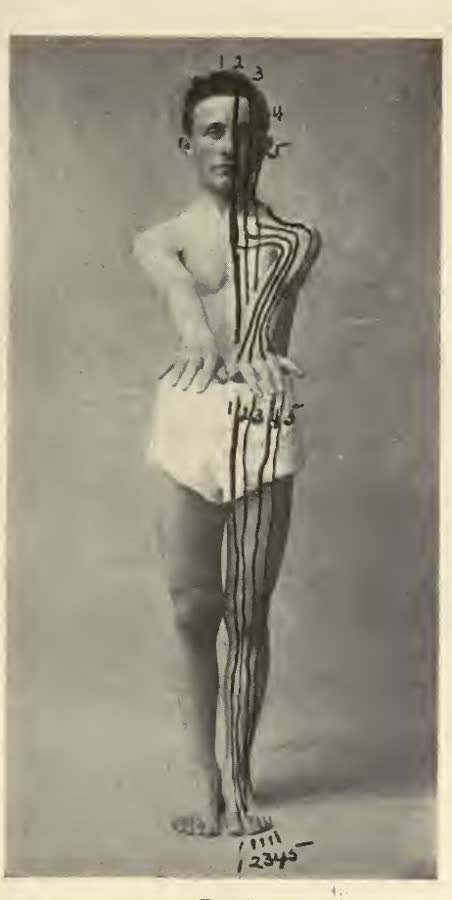
People have always drawn maps on the body. Now we can measure one.
Fitzgerald's ten zones, 1917 — the ancestor of every massage & reflexology chart.
Fitzgerald divided the body into ten longitudinal zones — press here, affect there. Meridian
charts, reflexology feet, dermatome maps: the same move, repeated for millennia. The maps disagree
with each other, but the intuition survives every era: the body is spatially organized, and
working on one region influences another.
Bioelectricity gives us a developmental body map that is measured, not asserted. Voltage
reporter dyes show real spatial prepatterns — regions of tissue holding different Vmem
set-points that specify what grows where. It's a map you can image, perturb, and re-image.
The "electric face" — a measurable voltage map that appears before the anatomy it predicts. Vandenberg, Morrie & Adams (2011), Levin Lab, Tufts.
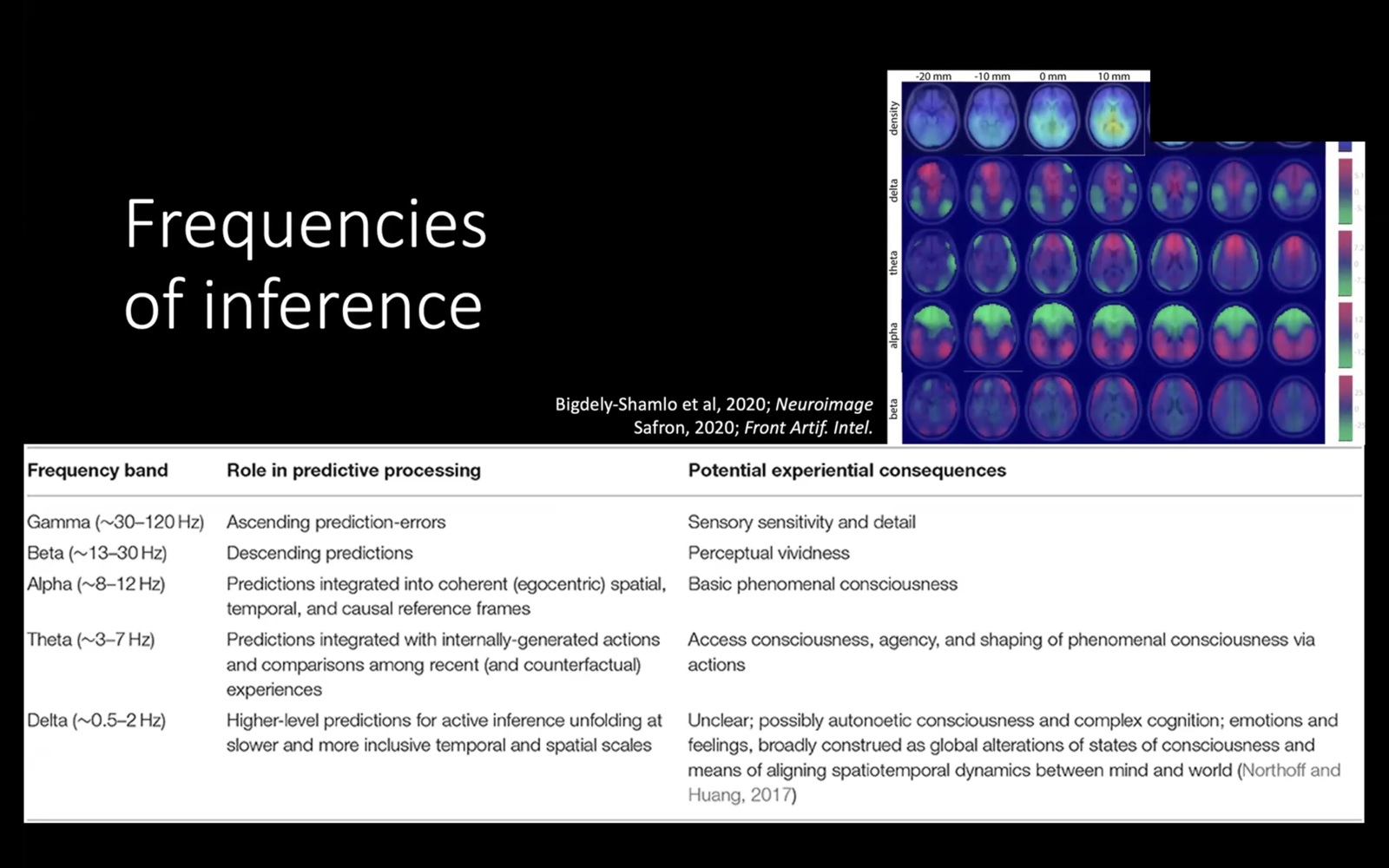
Different EEG bands = different scales of prediction.
If cognition is hierarchical inference, each oscillatory band carries a different layer of the predictive stack: gamma is the ascending error signal, beta the descending prediction, alpha integrates them into a frame, theta brings agency in, delta sets the slow context. Bioelectricity isn't just resting potentials — it's computational potentials at multiple harmonics simultaneously.
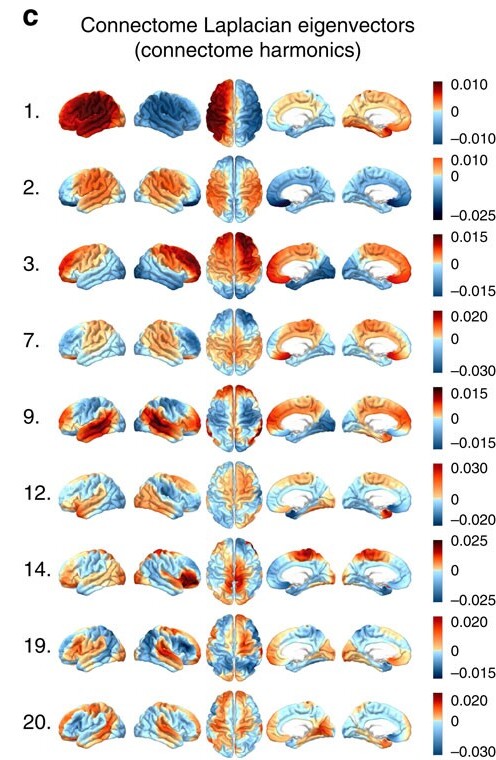
Treat the brain's wiring as a graph and take the eigenmodes of its Laplacian — the connectome's harmonics (the same math as a vibrating drum-head, on the whole brain). Resting-state fMRI is a weighted sum of these modes, and a psychedelic measurably re-weights which ones ring.
Connectome harmonic modes on the cortex (modes 1–20). Atasoy et al., Nat. Commun. 2016, Fig. 1c (CC BY 4.0).
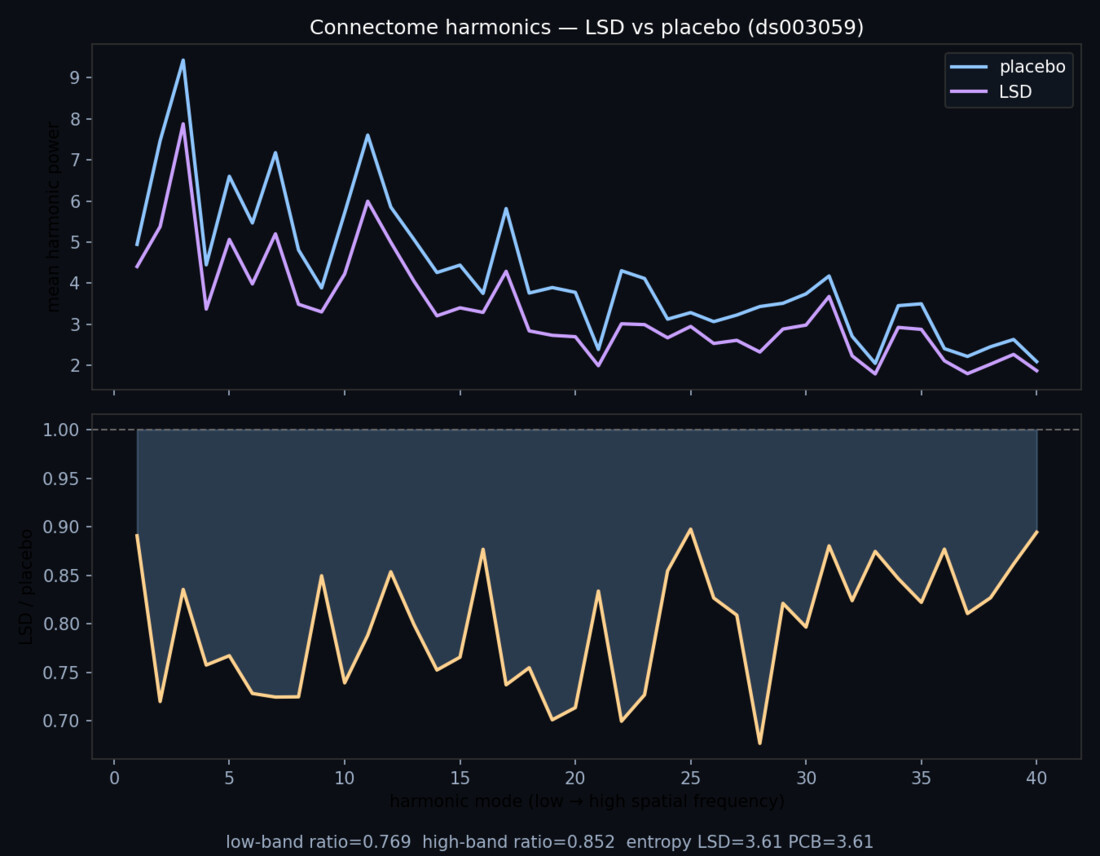
Under LSD, low-frequency harmonics lose power (ds003059, n=12). Connectome-harmonics simulator.
Spectrum reorganizes — LSD suppresses the low-frequency modes (Atasoy 2017).
Geometric latent space — the seven Yeo networks fall out of wiring alone, unsupervised.
Shape vs. wiring — LSD shifts the brain toward smooth cortical-geometry modes (12/12 subjects; replicates in psilocybin).
Less consonant, not more — the spectrum grows more entropic under LSD, not more symmetric.
45 / 49
Slide 46 · A skeptic's footnote
ProbKnow · probknow.com · Frequency & Energy Healing Devices · June 2026
"Frequency" is real physics. Most "frequency healing" isn't.
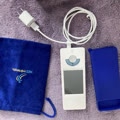
The same word covers two very different things. We logged 14 frequency- / energy-healing devices as testable claims and scored each by the weight of evidence. Most sit in the bioresonance / bioenergetic family, which has no validated basis; a few rest on a real mechanism (PEMF, far-infrared, shockwave) but with marketing that runs well past the evidence.
14
Devices logged
10
Largely unsupported
3
Real underlying basis
Rife / Spooky24%Rife / Spooky2 · no credible evidenceThe original frequency-healing lineage (Royal Raymond Rife, 1888–1971). Spooky2 pairs a generator with a 50,000+ frequency database; the Plasma model transmits up to 3.5 MHz. Claims specific frequencies shatter pathogens “like an opera singer shattering glass” — debunked for cancer, and the FDA/FTC have taken enforcement action against sellers making disease claims.
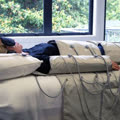
BEMER32%BEMER · largely unsupportedThe best-known consumer PEMF brand: ~8-minute mat sessions claimed to boost microcirculation (vasomotion), performance, and recovery. FDA-cleared and the mechanism is biologically plausible, but much of the supportive literature is small or manufacturer-affiliated, and independent replication is limited.
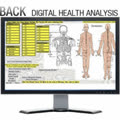
SCIO / QXCI / Indigo6%SCIO / QXCI / Indigo · no credible evidenceBill Nelson's “Quantum Xrroid Consciousness Interface” family — claims to scan the body against ~9,000 frequencies and transmit corrective signals. The inventor fled US fraud charges; the FDA characterizes the family as having no validated diagnostic or therapeutic basis, and readings are not reproducible.
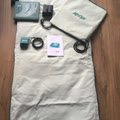
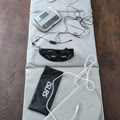
Biomat (Richway)32%Biomat (Richway) · largely unsupportedA mat combining far-infrared heat, “negative ions,” and amethyst crystals. FDA-cleared for what heat legitimately does — temporary relief of minor muscle pain. The ion and crystal “energy” claims have no scientific support; no rigorous trial shows it outperforms a simple heating pad.
AO Scan (Solex)7%AO Scan (Solex) · no credible evidenceA phone-based bioresonance scanner (~$149/month subscription) claiming to read 120,000+ “Blueprint Frequencies” from your voice, then broadcast corrective ones back. Solex's own materials disclaim medical or diagnostic use; bioresonance scanning as a category has consistently failed controlled testing.
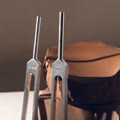
Biofield Tuning44%Biofield Tuning · mixed, mostly weakEileen McKusick's method: weighted tuning forks worked through the body's claimed “biofield.” The most credentialed corner of this space — published book, MA thesis, worldwide practitioner training. Sound therapy has genuine relaxation evidence, but the biofield itself is not scientifically validated.
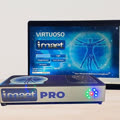
IMAET8%IMAET · no credible evidenceA computer-based electrodermal (EAV-family) system claiming to clear allergies and rebalance immunity by transmitting corrective frequencies — even remotely, without the person present. The EAV device family has no validated basis; real allergy desensitization requires immunologic exposure, not signals.
FLOWpresso52%FLOWpresso · real basis, overstatedA 3-in-1 full-body suit: pneumatic compression + far-infrared heat + deep pressure. FDA Class II cleared, prescription-only. Compression is evidence-based for lymphedema and venous circulation, and deep pressure plausibly aids relaxation — but the “detox” framing is unsupported (your liver and kidneys do that).
'Mold Wizard'9%“Mold Wizard” · no credible evidenceAn app advising you to play audio tracks loudly overnight to “eliminate mold” in a home or car. Some frequencies (~250 Hz) inhibit certain molds in petri dishes — but that doesn't transfer to real rooms. EPA guidance: fix the moisture source and physically remove the mold; sound is not a recognized method.
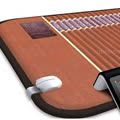
Omnium1 Mat (Swiss Bionic)53%Omnium1 Mat · real basis, overstatedA tablet-driven whole-body PEMF mat (low-microtesla sawtooth field) with optional light/sound brainwave entrainment. PEMF is genuinely FDA-approved for stimulating healing of nonunion bone fractures, with some RCT support in osteoarthritis — but broad whole-body wellness claims lack independent trials.
NES Health10%NES Health · no credible evidenceA scan reads your “Human Body-Field,” then practitioners apply the miHealth handheld plus liquid “Infoceuticals” — drops said to carry corrective informational patterns. No plausible mechanism, no randomized-trial support; reported benefits are consistent with placebo and practitioner attention.
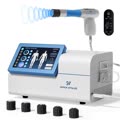
Extracorporeal Shockwave (ESWT)84%ESWT · clinically supportedFocused acoustic shockwaves — the same physics as lithotripsy, the standard of care for kidney stones. Multiple RCTs and meta-analyses support ESWT for plantar fasciitis, calcific shoulder tendinopathy, and tennis elbow; FDA-cleared for specific orthopedic uses. Only the anti-aging/cellulite marketing outruns the evidence.
Hi Tech Air Reactor 10112%Hi Tech Air Reactor 101 · no credible evidenceA photocatalytic-oxidation (PCO) air device claiming to destroy mold and mycotoxins “at the molecular level.” PCO is a real technology, but the efficacy evidence is testimonial, such devices can generate ozone, and no air unit can remediate established mold colonies — the EPA cautions against relying on them.
—
Healy13%Healy · no credible evidenceA phone-controlled microcurrent wearable sold via multi-level marketing, with 230+ frequency “wellness” programs. Its FDA 510(k) clearance covers only the TENS-like local pain-relief function — not the bioenergetic programs, which Healy itself states are not clinically established.
No credible evidence Largely unsupported Mixed — real basis, overstated Clinically supported
46 / 49
Slide · How medicine became a market
1800s · patent medicines · Britain & the United States
The first mass pharmaceutical market was household self-medication.
Pharma's first scalable business model looked like consumer packaged goods, not laboratory
R&D: common complaints, cash purchase, memorable brands, enormous advertising reach. Tonics,
laxatives, "blood purifiers" — proprietary through brand, secrecy and distribution, not
molecular patents.
£0.5M → £4M
UK patent-medicine sales / yr, mid-1800s → 1900 (nominal £)
1 per 2 Americans
Patent-medicine almanacs printed, late 1800s US
Brand and distribution came before modern clinical proof.
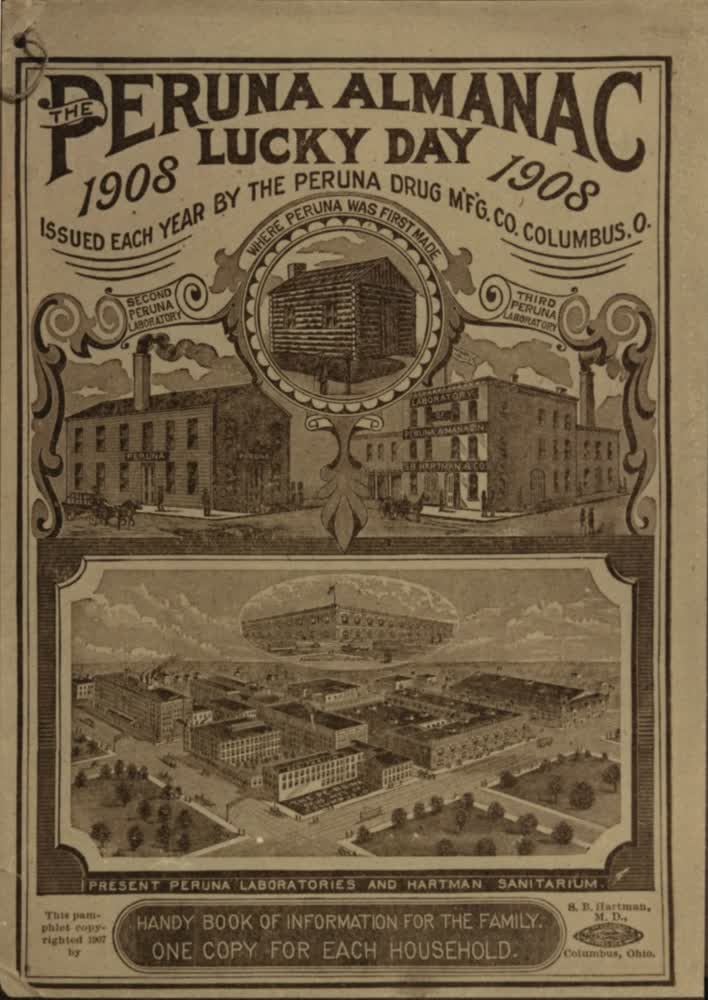
Peruna almanac cover — manufacturers printed advertising almanacs from the 1840s on. (DPLA, public domain)
— / —
Slide · How medicine became a market
1880s → present · who pays selects what gets made
The buyer changed — and selected a new kind of medicine.
Modern pharma = reproducible product + regulatory evidence + reimbursing payer. The deeper shift:
from the patient buys a bottle to a payer finances a medically defined treatment pathway.
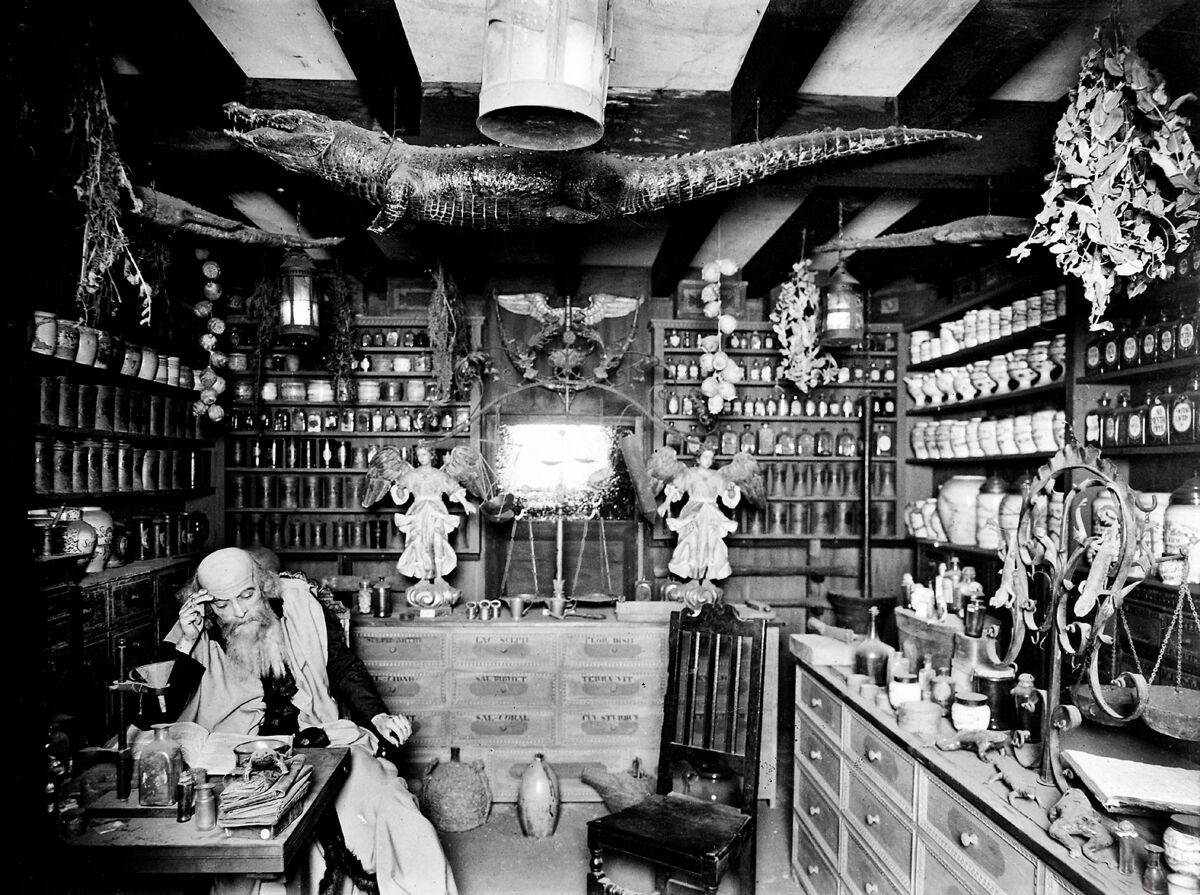
Where it started: the apothecary's shop — the patient buys a bottle. Wellcome Collection.
— / —
Slide · How medicine became a market
1960 → 2024 · US national health expenditure (CMS)
Health became an 18%-of-GDP economy.
US health spending as a share of GDP, 1960–2024 (CMS national health expenditure accounts; dollars are nominal).
Where the 2024 dollars go:
Hospital care31%
Physician & clinical services21%
Retail prescription drugs9% · $467B
Pharma is the most IP-intensive part of health — not the largest part.
Global health expenditure more than doubled in real terms, $4.2T (2000) → $8.5T (2019) — WHO.
Global life expectancy, 1900–2023 — more than doubled. (Our World in Data)
23% → 3.6%
Children dying before age five, 1950–2024 — an ~84% reduction. (OWID)
154 million
Lives saved by vaccination, 1974–2024 — ~94M from measles alone. (WHO)
Smallpox: eradicated
First human disease eliminated worldwide, 1980 — after ~300M deaths in the 20th century. (WHO)
TB: ~83M lives saved since 2000 (WHO)HIV: AIDS deaths down 73% from the 2004 peak (UNAIDS)
Medicine transformed childhood death, infection, and premature mortality from ordinary facts of life into increasingly preventable events.
Outcomes reflect medicine, vaccination, sanitation, nutrition, public-health systems, and rising living standards — not pharmaceuticals or patents alone.
— / —
Slide 45 · The labs landscape
Survey · 9 featured labs + ~75 tracked PIs
The field is distributed.
Pattern formation · regeneration
Levin Lab · Allen Discovery Center
Tufts University
Bioelectric control of anatomy — two-headed planaria, xenobots, anthrobots, BioDome.
Bio-inspired engineering
Wyss Institute
Harvard University
Pattern memory, AI top-down regulation, multiplexed Xenopus culture, therapeutics.
Computer-designed organisms
ICDO
Tufts & University of Vermont
Levin × Bongard joint institute — life-machine hybrids, regen medicine, cancer targeting.
Computational morphogenesis
Lobo Lab
UMBC
Automated discovery of regulatory networks for planarian regeneration.
Evolutionary robotics
Bongard Lab · Proteus
University of Vermont
Xenobot co-creator — morphological computation, co-evolved brains and bodies.
Mechanobiology · organs-on-chips
Ingber Lab
Wyss Institute · Harvard
Organs-on-chips, tissue mechanics, the engineering arm at Wyss.
Voltage imaging tools
Cohen Lab
Harvard University
Optopatch, Archon, the GEVI toolkit that lets you film a cell think.
Bioelectric oncology
Gentile Lab
Medical Univ. of South Carolina
K+-channel activators (NS1643) → senescence in breast and colon cancer.
Active inference · basal cognition
Pezzulo Group
CNR · Rome
Anticipatory cognition — predictive frame for cells, tissues and bodies.
…and the wider network around them — ~75 PIs the paper scanner watches each week (watchlist.ts)
Levin Lab core · 39 active
Michael Levin, Patrick McMillen, Vaibhav Pai, Wesley Clawson, Hananel Hazan, Franz Kuchling, Juanita Mathews, Federico Pigozzi, Yanbo Zhang, Caitlin Grasso, Jack Lindsay, Jayati Mandal, Patrick Erickson, Tomáš Pelikán, Doug Blackiston · + 24 more
Voltage imaging & tooling
Adam Cohen (Harvard · GEVIs), Ed Boyden (MIT · Archon), Eve Marder (Brandeis), Donald Ingber (Wyss)
Wound currents & channelopathies
Min Zhao (UC Davis), Mustafa Djamgoz (Imperial), Richard Nuccitelli, Christine Pullar (Leicester), Colin McCaig, Ann Rajnicek (Aberdeen), Richard H. W. Funk (TU Dresden)
Saverio Gentile (MUSC · Kv11.1 / NS1643), Mustafa Djamgoz (voltage-gated Na in metastasis)
Morphogenesis · dev-bio
Stuart A. Newman (NYMC), Aneta Koseska (MPI), Matthew Harris (Harvard), Koji Tamura (Tohoku), Bassem Hassan (ICM Paris), Kelly McLaughlin (Tufts)
Basal cognition · unconventional substrates
František Baluška (Bonn), Stefano Mancuso (Florence), Audrey Dussutour (CNRS · slime moulds), Eshel Ben-Jacob, Andy Adamatzky (UWE · fungal computing)
Theory · active inference · xenobot collaborators
Karl Friston (UCL), Chris Fields, Josh Bongard (UVM · xenobot co-author), Sebastian Risi (ITU · neural CA), Giovanni Pezzulo (CNR)
Cross-disciplinary collaborators
Daniel Ari Friedman (Active Inference Institute), Doug Blackiston (Tufts · xenobot construction lead) — plus Wyss / ICDO / Allen-Discovery-Center engineering staff.
45 / 49
Slide 46 · The latent platonic space
Concept · Symposium on the Platonic Space · Levin & Hazan 2025
The forms may be discovered, not invented.
"Platonic space" names a structured, non-physical space of patterns — the properties of
mathematical objects, and perhaps the higher-agency patterns we detect as anatomy, physiology,
and behavior across the biosphere.
Its contents may in-form events in the physical world — constraining physics and enabling
biology. Systems don't invent a body from scratch; they navigate toward a form that
already sits in the space of possibilities.
The symposium uses Plato and Pythagoras as a springboard, not a doctrine — a way to go
beyond "emergence" and ask, concretely, how the latent space of possibilities gets explored.
Interdisciplinary symposium organized by Michael Levin & Hananel Hazan → /platonic-space
Hand-built schematic — a structured space of forms "in-forming" the physical world.
46 / 49
Slide 46 · The latent platonic space
Concept · Levin & Hazan symposium 2025
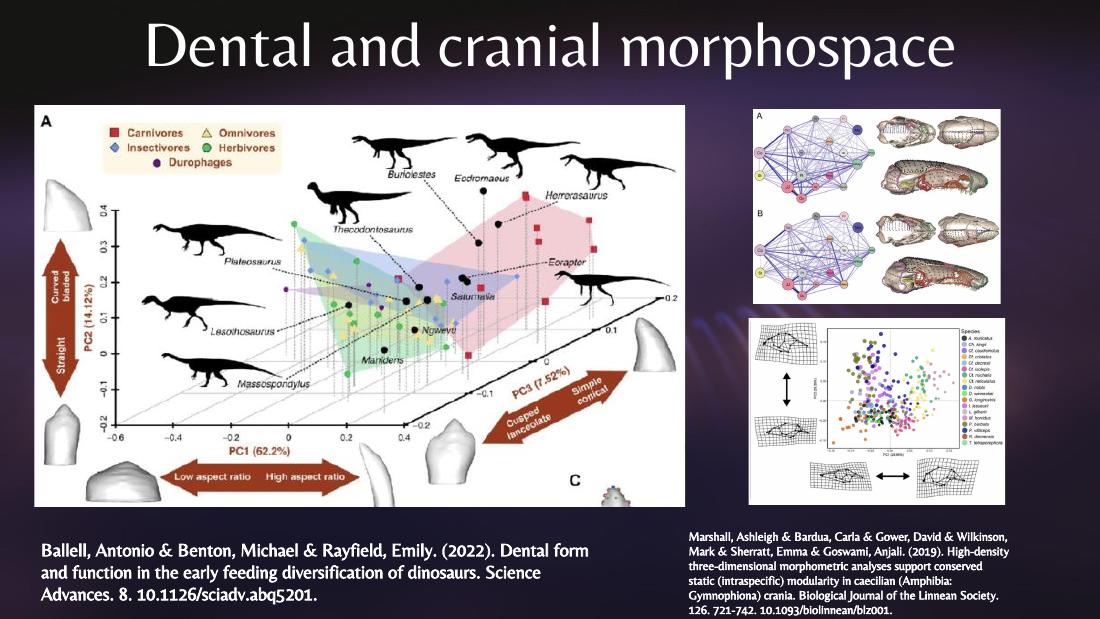
Raup's morphospace, generalized.
If voltage maps can navigate cells through the space of possible bodies, where does that space
live? Levin's working answer: a structured, non-physical space of forms, patterns and
higher agencies that biological systems (and minds, and AI) appear to discover, not invent.
Attractor landscape
Anatomies are stable basins the system gravitates toward. Bioelectric circuits encode which.
Active inference
Cells minimize surprise against a target morphology — Friston's framework, applied to shape.
Cognitive platonism
Forms are real as operational constraints, not as transcendent objects (Dodig-Crnkovic).
Convergence
Biology, cognition and large-scale ML all seem to land on overlapping patches of this space.
Generalized · Ballell et al. 2022 dinosaur teeth + Marshall et al. 2019 caecilian skulls · via M. Levin's slides
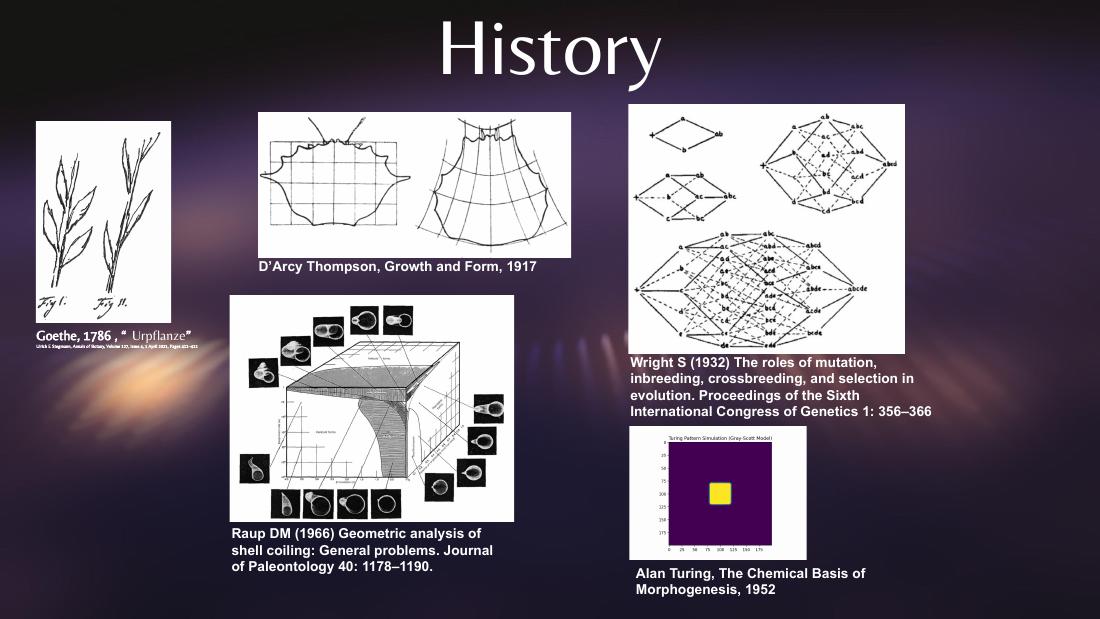
Conceptual lineage · Goethe → D'Arcy Thompson → Raup → Wright → Turing · via M. Levin's slides
Vmem wave propagating across a tissue grid · inspired by BETSE bioelectric simulations (Pietak & Levin 2016).
46 / 49
Slide 47 · The landscape
From idea to ecosystem: who's building, what they own, where capital is moving.
One map of everything the Nexus tracks — 21 organizations clustered by type, the
patents mapped to them (number inside each node), and the active deals seeking capital.
Legend
Universities
Startups
Medical device
Pharma
Institutes / orgs
Patent (mapped IP)
Active deal
21 organizations
26 patents tracked · 11 mapped
3 active deals
Live snapshot from the Bioelectricity Nexus deal room & patent portfolio · node size scales with mapped patents